|
One Ukrainian tourist website proclaims: “Ukraine is the geographical center of Europe!” And then, confusingly, the first sentence after that title is, “Ukraine is one of the mightiest countries in Eastern Europe.”
One of those proclamations is true: Ukraine is the biggest country that is wholly in Europe. Russia’s European piece is bigger than Ukraine, while Denmark is bigger than Ukraine if you count its Greenland territory. However, if you ignore these two cases, then Ukraine is the biggest. In fact, it’s almost as big as Texas.
Starting in 1999, I visited Ukraine every five years. Each time I returned, Ukraine seemed to have taken three steps forward and two steps backward.
Traces of communism
In 1999, I flew into Ukraine’s capital, which is often called Kiev, but we will use its official name: Kyiv (pronounced Kee-v). I stayed in the Mir Hotel. I learned that mir is a cool Eastern Slavic word that has two meanings: world and peace.
Although communism had officially disappeared nearly a decade before, its remnants were everywhere. For example, every floor of the hotel had a middle-aged, overweight female gatekeeper who was in charge of the floor. Besides having the thrilling task of policing the floor, this stern woman would also hold your keys, which clearly the receptionist in the lobby was incapable of doing. Similarly, at the bottom of every subway escalator, there was a guard whose stimulating job was to verify that life around the escalator was OK. Communism’s goal was to give everyone a job, so it invented millions of useless jobs. Many of these pointless jobs remain.
Another example of a communist leftover was the controlling and corrupt police force. In 2004, when I saw Kyiv’s colossal titanium Mother Motherland statue from far away, I used my camera’s zoom to take a photo. While snapping the picture, a policeman ran up and ordered me to stop. He thought I was taking a photo of a nearby military building that was in the line of sight of the distant statue. I showed him the photos so that he could believe me when I said that I wasn’t a spy.
Although I never faced corruption during any of my visits, in 2010, travel blogger Justin Klein got “shaken down” by police officers on five separate occasions during a short trip.
He offered tips on how to avoid such encounters:
- Keep quiet when the police are around (so they don’t overhear you speaking English).
- If they ask you for a bribe, reinforce that you’re just a poor traveler who is staying in cheap hostels and traveling on second-class trains.
- Say that you’ve already had to pay other officers “fees” for minor “violations.”
- Carry little cash in your wallet (or at least the wallet you show them); they’re unlikely to walk you to a bank to get more money, so you might get away with a small bribe.
- Pretend you don’t understand them and hope they get bored.
Justin nearly left Ukraine early out of frustration, but he’s glad he stayed because he loved the people and the country overall.
Another communism hangover is that arbitrary rules are posted everywhere. Fortunately, it’s all in Cyrillic so you probably won’t understand them, although I learned to spot their favorite phrase, “Strictly Forbidden!” Ukrainians probably ignored half of the rules under communism, but nowadays they seem to ignore all the rules.
The strictness of our laws is compensated for by their lack of enforcement. — Whispered Soviet saying
|
|
Read more... [Ukraine]
|
What divides Romania and Moldova
My bus crossed the Prut River, which divides Romania and Moldova. It’s basically the only thing that divides Romania and Moldova. Linguistically, they’re identical. In 2002, the Moldovan Minister of Justice said that Romanian and Moldovan are the same language. Moldova’s Education Minister and President agreed. Nevertheless, in 2003, a Moldovan-Romanian Dictionary was published, which is about as useful as having a New York-Texas Dictionary—a complete waste of paper.
Moldova is torn: among its population, three times more people claim to speak Moldovan than to speak Romanian. Since the only real difference between these languages is their name, this poll implies that Moldovans believe that there’s more than just the Prut River that separates them from Romanians.
A 2009 survey indicated that 47 percent of Moldovans believe that the Romanian and Moldovan identities are “different” or “entirely different,” while only 26 percent felt they were “the same” or “very similar.”
The Soviets encouraged the belief that Moldovans are different than Romanians by making Moldovans use the Cyrillic alphabet. This took Moldovans back over 200 years, when they (and the Romanians) used the Cyrillic alphabet. However, after gaining their independence from the USSR 20 years ago, Moldovans reverted to the Latin alphabet, thereby making their language indistinguishable from Romanian. Nevertheless, the notion that they are different remained. That partly explains why most Moldovans do not want to reunite with Romania.
Ethnically, 70 percent are Moldovan/Romanian and 20 percent are Russian/Ukrainian. Most Slavs live on Moldova’s eastern edge, where they make up the majority. Lastly, four percent of Moldovans are ethnic Gagauz, who are Christians that speak a Turkish dialect. The reason this tiny country is so divided is that the region has traded among various rulers more times than a stock on the New York Stock Exchange.

|
|
Read more... [Moldova]
|
|

Hallelujah! That's what I shouted when I first entered Romania.
It was September 2004 and I had spent the previous four months traveling in countries that spoke languages that were either Baltic, Slavic, or Martian (i.e., Hungarian and Albanian).
For many moons I was hopelessly illiterate: my knowledge of Romance languages was useless and my ludicrously simple Russian was futile.
Finally, I found an Eastern European language that felt familiar and easy. Sure, I only understood about 20 percent of it, but Romania felt like a Latin oasis in a Slavic desert.
The Romanian language brings up the tiresome defining-Eastern-Europe debate again. We've primarily used geography to define Eastern Europe, although we've also considered Eastern Europe's common historical connection to communism.
Still, there's another way to draw Europe's east-west dividing line: using the Catholic-Orthodox borderline. In that case, Lithuania, Poland, Hungary, Slovakia, Croatia, and Slovenia would all fall on the Catholic side, while Russia, Belarus, Ukraine, Romania, and much of the Balkans would fall in the Orthodox camp.

|
|
Read more... [Romania]
|
A quick tour through Bulgarian history
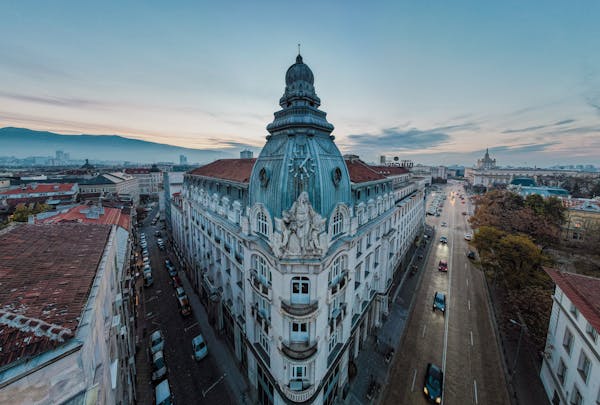
The beauty and history embedded in Veliko Tarnovo motivated me to learn more about Bulgaria's history. Over 5,000 years ago, Thracians were the first major civilization to show up in Bulgaria. The Romans took over in the first century, establishing places like Plovdiv. In the seventh century, the Bulgars, who were descendants of people from Central Asia (near Iran), migrated to Bulgaria. They mixed with the locals and, in 681 AD, carved the first Bulgarian state out of a part of the Byzantine Empire. After a few hundred years, the Byzantines reconquered the land, but they felt the need to poke out the eyes of 15,000 Bulgarians first.

|
|
Read more... [Bulgaria]
|
|

Turkey is one of only four countries that want to be associated with Eastern Europe (the other three are Belarus, Moldova, and Ukraine).While every other Eastern European country stubbornly resists the Eastern Europe label, Turkey embraces it. And yet, many Europeans don’t want to give Turkey the “honor” of being in Eastern Europe, because they believe that Turkey isn’t a part of Europe.
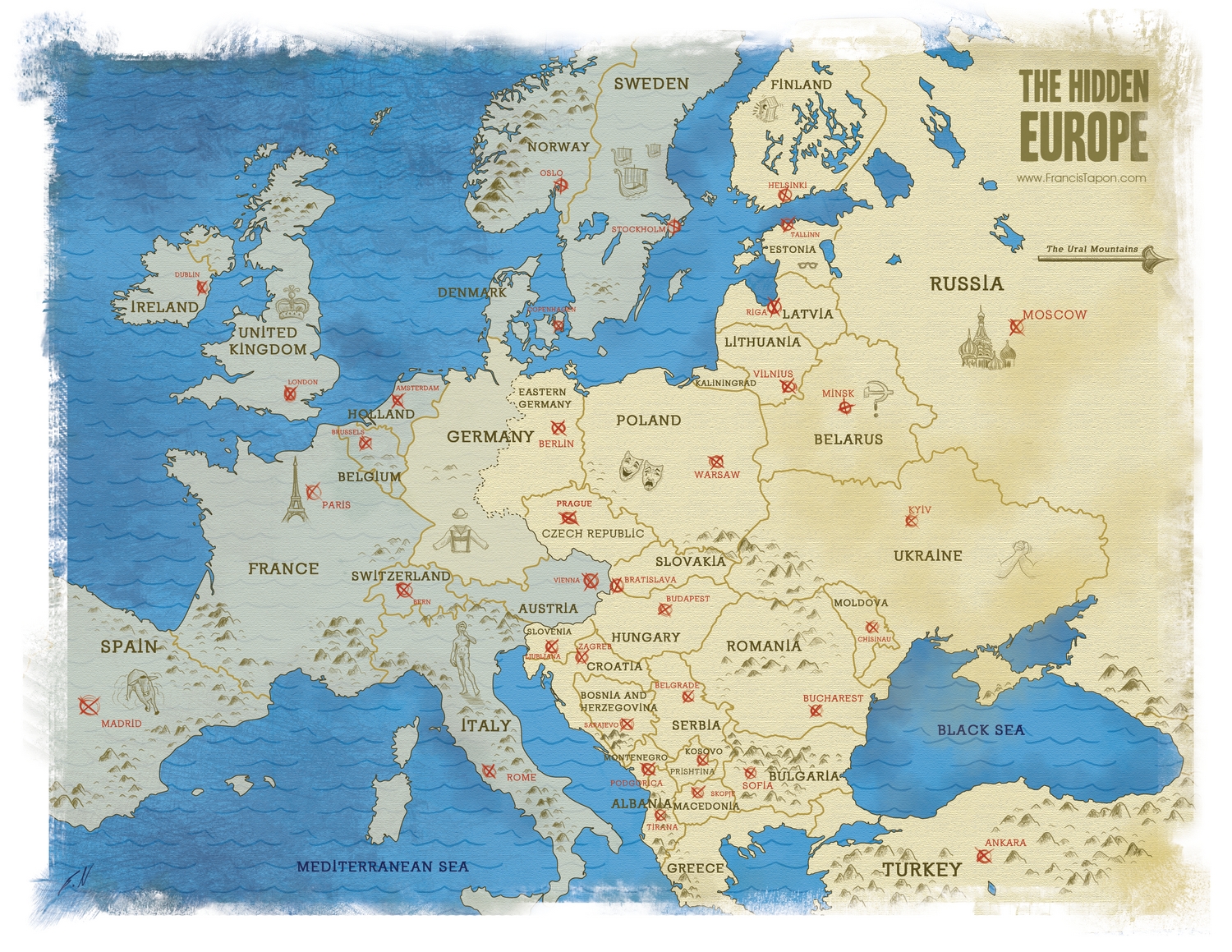
Geographically, Turkey has only a toe in Europe (see map below). About three percent of Turkey is in Eastern Europe; the rest is in Asia. Because of this lopsided ratio, it’s tempting to exclude Turkey from this book. Still, just like eastern Germany is a legacy member of Eastern Europe, Turkey (due to the Turkish Empire’s dominance in the Balkans for five centuries) is also a legacy member. Moreover, modern Turkey is part of NATO, has strong ties to the Balkans, and is a serious EU candidate. In addition, while only a small part of Turkey lies in Europe, about 10 million Turks live in that part—that’s a bigger population than many European countries. Thus, we must consider Turkey. Nevertheless, we’ll focus on Turkey’s western side—the part that’s most connected to Europe. I plan to analyze Turkey much more thoroughly in Book Four of the WanderLearn Series, which will cover the Middle East.
Before we take our short tour of Western Turkey, let’s consider the country’s name. Several Turks told me that they hate it when their country is called Turkey instead of Türkiye (sounds like Tur-ki-yea). Of course, they wouldn’t have a problem with Turkey if the word didn’t have three unflattering meanings: a winged animal, a jerk, and a flop. If turkey meant awesome, then no Turk would complain. Hungary faces a similar problem with its name. Hungarians call their country Magyarország. Like the Turks, Hungarians are tired of people cracking jokes about their country.
Ethiopia was disappointed with the World Cup draw. They were hoping to get Turkey, but got Hungary instead. — Bad joke
|
|
Read more... [Turkey]
|
|
According to my tastes, Greece has the most delicious food in Eastern Europe. They energize their meals with fresh ingredients like tomatoes, eggplant, feta cheese, onions, olive oil, yogurt, zucchini, nuts, and honey. During the Byzantine and Turkish period, Greeks incorporated spices like oregano, dill, bay leaves, and mint.
Today, popular dishes include souvlaki (anything marinated in olive oil, salt, pepper, oregano and then skewered), dolmathes (grapevine leaves stuffed with rice, veggies, and sometimes meat), and tzatziki (yoghurt with garlic and cucumber). Even their fast food is delicious: gyros (meat roasted on a vertically turning spit and served with sauce and garnishes on pita bread) will make you give up hamburgers. Finally, baklava (phyllo pastry layers filled with nuts and drenched in syrup or honey) is a decadent dessert to end any meal.
It’s all Greek to me
Over dinner, my four Greek hosts gave me a crash course on Greek. Niki was particularly instructive because she has a degree in the ancient Greek language. Basic phrases include yashoo (hello), adio (goodbye), puinne. . . (where is. . .), posho kani? (how much?), tikanish? (how are you?), treno (train), pote (when), tikanish? (how are you?), poli kalo (very good), katalava (understand), signomi (sorry), and, most importantly, efharishto (thank you).
About every 10 minutes Niki (whose name means Victory) loved to remind me that some English words I said were derived from Greek. She could have interrupted me more often: about 12 percent of the English vocabulary has an ancient Greek origin, including words like mathematics, astronomy, democracy, philosophy, thespian, athletics, theater, and rhetoric.
Still, this doesn’t mean Greek is easy for us. Most Greek verbs are irregular. They have four cases. They even have three ways to write their sigma character. The first is upper case (Σ), the second is lower case (σ), and the third is used only when the word ends with the sigma character (ς). Σo σentenceς would read juσt like thiς.
There are two other annoying things besides the Greek alphabet. First, while most European countries use a word that sounds like bus or autobus, the Greeks call that vehicle a leoforio. WTF? Second, to say yes, you have to say neh, which sounds like a negation in most European languages. So when I ask, “So the leoforio leaves today?” they’ll nod and say, “Neh!” Meanwhile, to say no, you say ohhi. As William Shakespeare said, “For my part, it was Greek to me.”
There is a misleading, unwritten rule that states if a quote giving advice comes from someone famous, very old, or Greek, then it must be good advice. — Bo Bennett
|
|
Read more... [Greek food and language in Thessaloniki]
|
|
After learning about my new book, The Hidden Europe, a reporter from a San Diego newspaper asked me for tips on finding a reasonably priced accomodation in Dubrovnik, Croatia. Because everyone has different definitions of what is "reasonably priced," here are 6 good options to stay in Dubrovnik in 2012:
1. Hotel Excelsior Dubrovnik. Five star hotel outside Old Town. 158 rooms/suites. Price $150-350/night. 2. Hotel Uvala. It's a 4-star hotel that has rooms that feel like the Holiday Inn. It's near the beach and not in the Old Town. It's $150-250/night. 3. Begovic Boarding House. They have dorm rooms, singles, and doubles. They have a shared terrace with a view. Prices range from $20 to $60. 4. Youth Hostel. Youth Hostel Dubrovnik resides outside the Old Town. You get there after a 20 min walk from the bus station and it takes you 15min to get to the Old Town. Roughly $20/night per person in a dorm-room arrangement. 5. Be spontaneous! This is what I like to do and it works well if you're not hauling around lots of luggage. Look for homes with signs that say "Zimmer" (room, in German) or "Sobe" (rooms, in Croatian). Knock on their door, negotiate with the owner, and then stay with them. You'll stay in a real Croatian home, and you'll usually have your own bathroom. There are hundreds of rooms available in Dubrovnik, both in the Old Town as well outside of it. So you can almost always find a place pretty easily, even during the high season. If they're full, ask them to refer you to (or call) someone else. Obviously, places outside the Old Town are cheaper than those inside the Old Town. Prices vary: $25-50/night. 6. Stay in the Old Town in a 3-star apartment. Croatians will rent out their apartment, especially during the high-season. Rates vary from $75 to $150/night. The advantage is that you're in the Old Town and the price is a great value.
Then the reporter asked, "So, do you recommend staying in the Old Town?"
I replied: I've stayed both in and outside of the Old Town - they are both good options. As you might expect, outside the Old Town you'll get more bang for your buck, because to stay in the Old Town you're paying for the convenience of being in the thick of it. Still, the Old Town is pretty quiet at night, so don't expect loud noises. If you stay in the Old Town, make sure to find out how many steps you have to take to get to your apartment (sometimes it can be over 100).
Wherever you stay in Dubrovnik, make sure you see the other surrounding jewels: the rest of the Dalmatian coast, Kotor (Montenegro), and Plitvice Lakes National Park. |
|
|