Africa
On March 5, 2013, I started a five-year adventure that will take me across all 54 countries in Africa. Yes, even the crappy ones. The journey is called The Unseen Africa. I never left the African continent until mid-2018, thereby making it an immersive odyssey.
To get updates on my book and video tour, subscribe to my newsletter, and don't worry, you can easily unsubscribe.
Browse my GPS tracks to see where I went.
Below I left what I wrote before my trip. At the bottom of the page are the latest updates.
What are your goals?
- Visit every country in Africa.
- Film it to make a documentary and TV show about it.
- Write a book about Africa's unseen sides.
- Get a tan.
What's your general travel plan?
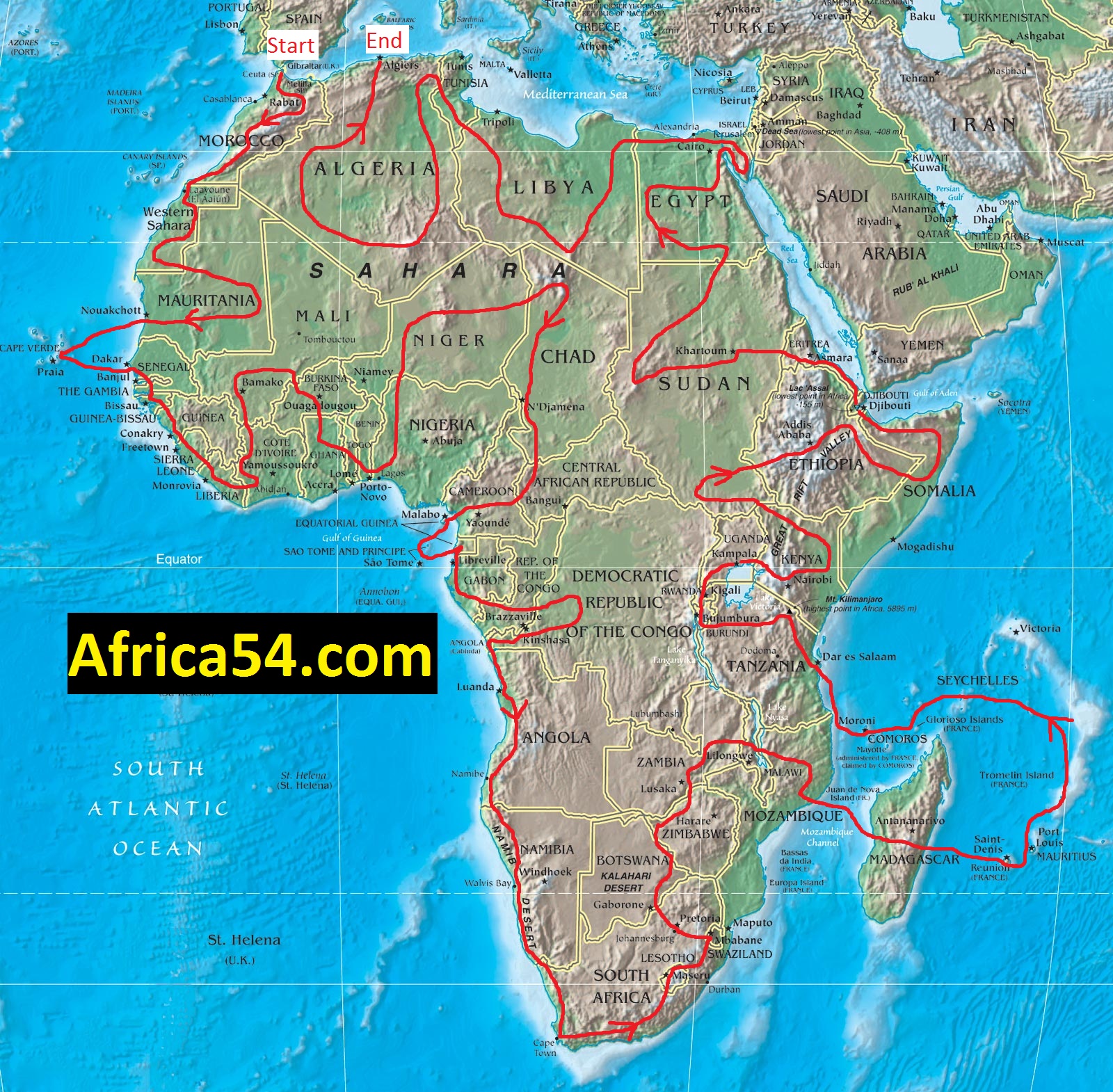
Follow the red line on the MAP on the right (move your mouse over the map to zoom into a section). I started in Morocco. I've gone through West Africa. I'm now going through Central Africa until I reach South Africa. Then I'll travel up through East Africa, eventually traversing North Africa (making sure to hit all the countries in between).
The red line gives you a rough idea of our journey's path. It crosses all the countries in Africa. Realistically, I will make adjustments, so don't analyze the red line too carefully.
I expect my real journey to be far less efficient, with lots of backtracking and circuitous ways to a destination. For example, just because the red line doesn't go to East Angola doesn't mean we won't go there. The only promise is that I will try to visit every country. If I follow the red line, I'll do just that.


How will you document the journey?
Four ways:
- Write a book. Just like I wrote a book about my 3-year trip to all 25 Eastern European countries, I will write a book about this 4=5-year trip to all 54 African countries.
- Film it. I am producing one made-for-TV pilot episode about the first country (Morocco). If that goes well, then there will be more episodes. The TV show (and book) will be called The Unseen Africa. I'm currently looking to team up with a video production company to turn the journey into a TV show. If you have contacts regarding this, let me know.
- Blog. I'll be blogging about once a month. (I'm not a hyper-blogger. I save my writing energy for my books.)
- Share photos on Facebook and tweet whenever possible.
Will you travel on foot everywhere?
No. Although I've backpacked 20,000 km (12,500 miles) in the mountains, Africa has two things that make it unattractive to walk across. First, it's mind-bogglingly big. Consider the following facts:
- The island of Madagascar is bigger than California.
- The combined territory of just three countries (Sudan, South Sudan, and Congo) is over half the size of the USA, including Alaska.
- The combined land of Algeria and Egypt are the same size as all of Western Europe combined (including France, Germany, Italy, Spain, the UK, Iceland, Norway, Sweden, and Greece)!
In short, Africa is bigger than your backyard.
Second, Africa has vast flat areas. As I learned on El Camino Santiago, I don't like flat. To top it off, it is often murderously hot in much of Africa. Imagine walking 10,000 km in hot, dry, flat deserts. I can barely imagine it. No thanks.
I will climb peaks and trek through jungles as much as possible. I'd love to get to the highest peak in every country. Although most are rather short, the logistics of getting to many of them will be a nightmare. Still, it is a great excuse to go to rarely seen places.
Will you have a vehicle?
Yes. In Spain, I bought a 4x4 truck. I put it on a ferry across the Strait of Gibraltar so that the journey can start in Morocco.
There are many downsides to having a car, including:
- Worrying about where to park it and what to leave in it.
- Unable do a one-way trek - you always have to get back to the car.
- Border crossings are more expensive - bribes, fees, insurance, and hassle increase dramatically.
- You're in a bubble: when you take public transportation or hitchhike, you interact with the people, which is my biggest joy in traveling. A car isolates you from that.
- Africa's road conditions are unforgiving, so maintaining the vehicle will be expensive.
- A car encourages you to take too much crap.
- You can break the "bubble problem" by picking up hitchhikers, thereby interacting with the locals. I've picked up over 1,000 African hitchhikers in the first 9 months.
- Compared to African public transportation, you can cover at least 5 times more ground at the same time and get to places that are hard to access. Taxis and hitchhiking options are sometimes non-existent.
- Sleeping options expand: you drive to remote locations to camp or find Couchsurfing hosts that are not on the public transportation routes.
- You can comfortably carry the heavy camera equipment that's necessary to shoot a TV show.
If it's too much of a headache, I can always sell it.
What is your rough schedule like?
- 2013: West Africa
- 2014: Middle Africa
- 2015: Southern Africa
- 2016: East Africa
- 2017: North Africa
- 2018: Finished!
How much time will you spend in each country?
I plan to spend, on average, five weeks in each country. That's not a lot of time, given that many of the countries are enormous. With 54 countries, that's about five years.
Why not skip some countries to spend more time in others? That's unacceptable to my goal of seeing all the countries of the world. Of course, I would love to spend more time exploring, but most people spend less than 2 weeks in one corner of Africa on their once-in-a-lifetime trip. I'm lucky that I can spend 4 years.
Also, one-month-per-country is an average. For example, I may only spend 3 days in Sierra Leone or Somalia, but spend 3 months in Morocco or South Africa.
What will slow you down?
If I find an idyllic spot, I will stay there for a couple of months to focus on my book and catch up on my digital life.
Won't you get robbed?
Yes, it's part of the budget. I plan to be robbed three times.
I'll look at the theft as a contribution to the African economy. The thief will spend the money he gets from me in Africa. That money will trickle into the economy when the thief buys anything. That money will help whoever provides that good or service to the thief. Seen in that light, getting ripped off in Africa won't feel so bad--it's a form of charity!
UPDATE: So far on the trip, I was burglarized in Cape Verde. Lost about $2,500. In Niger, someone stole my 64 GB memory card and its reader. My smartphone was pulled out of my pocket when I was tackled from behind in Accra, Ghana. In Cameroon, three people stole from me, but only one of those was violent, involving strangulation. In Rwanda and the DRC, a hitchhiker tried to steal from me. I was burglarized in Tanzania. There have been other incidents too. So my prediction was pretty wrong.
 Are you afraid?
A little. Some worry that I will be killed by some random guy, or get eaten by a lion, or die from a disease. Although I am pretty sure that I will be robbed and get sick at least once, what worries me the most is dying in a car accident. I've never been to Africa, but I know they drive like they have death wishes.
Also, thanks to Barack Obama's Kenyan background, no other region in the world loves America as much as Sub-Saharan Africa. That should translate into friendly treatment there. On the other hand, no other region in the world dislikes America as much as Islamic countries, which dominate North Africa. I'm not afraid, but in some places, I will be cautious, just like I would be in parts of America and Europe.
"What we get from this adventure is just sheer joy. And joy is, after all, the end of life. We do not live to eat and make money." - George Leigh Mallory, who died trying to be the first person to summit Mt. Everest
How will you avoid the war-torn regions?
Go around them. Most African countries dwarf European ones. If war rages in Mali, for example, you just have to avoid the hot-spots. Although that hot-spot may be as big as Italy, when the whole country is as big as Western Europe, it's easy to avoid "Italy." Also, I may just peek in the country for a day (like Somalia) to minimize the risk.

How often will I connect digitally?
Perhaps a couple of times a week. As the map below illustrates, most Africans don't have the Internet at home. The African country with the highest percentage of people with the Internet at home was Algeria. However, even there, less than half (48%) had it in 2012. Iceland had the world's highest Internet penetration rate (94%). Meanwhile, when Gallup surveyed 1,000 random people in Guinea, for example, nobody had the Internet at home.
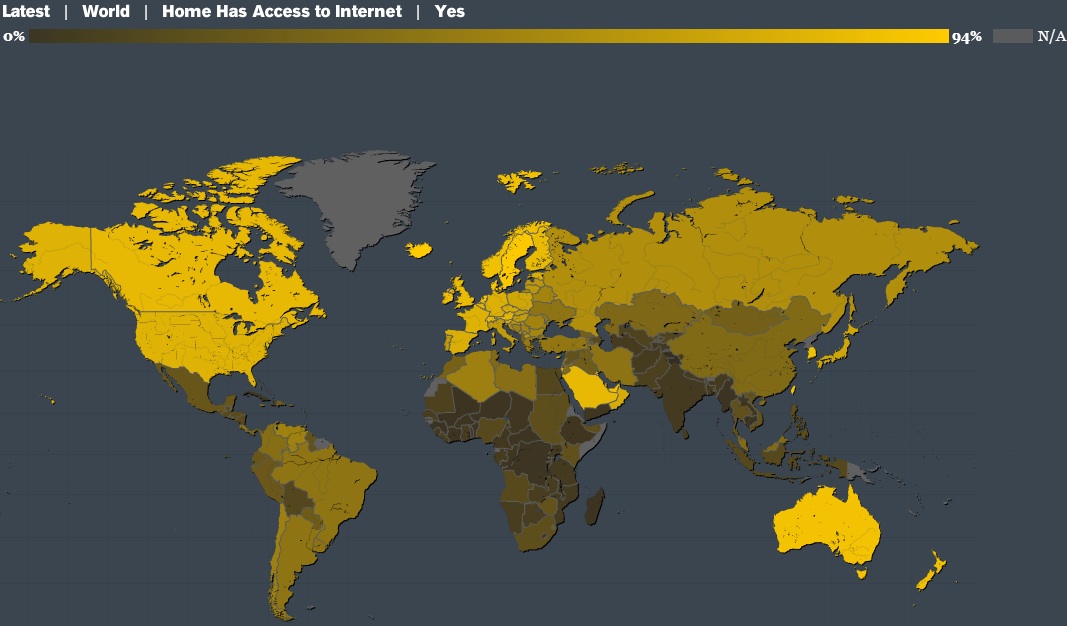
This is all changing quickly. Not only are Internet penetration rates rising fast, but nearly every African has a mobile phone. Soon they will upgrade to smartphones (or tablets) with Internet access. So while they may not have a PC at home, by 2017 many will have mobile Internet access.
Still, Africa is about 10 years behind the developed world. Therefore, I suspect that wifi will be rare outside of cities. This may mean that I will go for a couple of weeks without the Internet.
I'm used to that: when I was writing my book on Eastern Europe, I spent just one hour per week on the Internet for an entire year. While I walked across America twice, I checked email even less often during those seven months. Also, my mom is used to not hearing me for weeks. She doesn't like it, but that's what may happen.
Fortunately for my mom (and anyone else who wants to stalk me), Delorme has given me their InReach device which can track my movement.
Finally, I think travelers who spend so much time being digitally connected while they're traveling are doing themselves and the places they are visiting a disservice. They need to present and immersed in their environment. If you have one foot in digital land, then you're not truly 100% in the environment. Unplugging is good.
How will you travel?
I rough it more than most. I love doing it because it gives me a good perspective of the real people and culture, and it also lets you travel for longer. Therefore, Couchsurfing and camping will be my first choice, while hostels/hotels will be my last resort option. As the map below illustrates, Couchsurfing is sparse, but I'm sure random strangers will invite me to sleep in their backyard.

Will you take planes?
Only as a last resort. For example, it might be much cheaper to get to Africa's island nations (e.g., Comoros, Seychelles, Madagascar) by plane instead of by boat.
Can I come along?
I am happy to meet travelers along the way. Above you'll find a vague schedule. Unfortunately, I probably won't make it much more specific than that since I like to improvise while I travel. However, certain visas may dictate a few fixed dates along the way. Once the trip gets started, check this page and my Twitter or Facebook status. You can see the last place where I've checked in on my satellite map. If it looks like our paths could cross, then contact me.
Are there 54 countries in Africa?
Yes, there are 54 countries in Africa. There are also two quasi-states, Somaliland (a separatist region in Somalia) and Sahrawi Arab Democratic Republic (a separatist region in Western Sahara) that dream of becoming independent countries. Finally, there's Cabinda, Angola's exclave, which is attached to Congo. I intend to visit the quasi-states too because I don't want to have someone tell me a year or two after my long voyage that I "missed one." An easy way to tell someone about this page is to point them to Africa54.com.
Why the world needs a book about what we can learn about Africa
This video below spoofs the fact that the average person doesn't know much about Africa. What are 3 differences between Niger and Nigeria or Algeria and Angola? By the end of my future book, you should know. Enjoy the video...
If you have questions about this trip, I prefer that you post the question on my forum so that I don't have to answer it multiple times.
Below are the latest blog posts about Africa
- Traversing the DRC Solo Overland - The Rarely Seen Congo
- Tips for Student Travel in Africa
- Why I Hired Graham Gray Jones as a Video Editor & Colorist
- Where To Buy African Land
- What to See and Do in One Week in Tunisia
- Traveling Beyond Cairo's Pyramids To The Unseen Egypt
- Why Mauritius Is My Favorite African Country
- 10 Places Every Tourist Needs to Visit in Kenya
- Everything You Need To Know Before Visiting Kruger National Park
- 6 Must-Visit Destinations in South Africa
- How The Anou Empowers Moroccan Artisan Entrepreneurs
- Hospitality From A Bigamist Hitchhiker
- When My Car's Engine Blew Up In Guinea
- The Less You Know Your Guinean Bride, The Better
- What You Can Learn From Living With A Family In Guinea
- Did Zimbabwe Choose Correctly? 2018 Election Results
- 10 Holiday Ideas to Escape the Winter Blues in South Africa
- Why Your Ideas About Africa Are Misguided
- Defining Sub-Saharan Africa And The Countries In It
- History Of Tattoos In Africa
- How Did Africa Fare in the 2016 Human Freedom Index?
- Motorcycle Traveling In South Africa: 4 Things To Know
- Hiking Across Madagascar
- Luxury African Safaris for Adventurous Honeymooners
- Engagement: Taking the Plunge
Your comment will be deleted if:
- It doesn't add value. (So don't just say, "Nice post!")
- You use a fake name, like "Cheap Hotels."
- You embed a self-serving link in your comment.