Home Travels Eastern Europe

WanderLearn with Francis Tapon's Facebook PageFrancis Tapon's TwitterWanderLearn's general RSS
Connect with Francis!

Would you like see my 40-minute video of Traversing Spain Twice for free? Or how about getting four chapters of The Hidden Europe? And chapter 2 of Hike Your Own Hike? Get them all when you sign up for my bi-monthly newsletter below! I won't share your email with anyone. I hate spam too, so you can easily unsubscribe.

Email

Banner

Eastern Europe

Exploring the Hidden Europe in 2004 and 2008-2011

In 2004, I visited all 25 countries in Eastern Europe. You'll find the blog entries from that trip here. In 2008-2011, I returned to see what had changed since that time. With these two visits, five years apart, I accumulated enough material for my new book, The Hidden Europe: What Eastern Europeans Can Teach Us.

This blog now has many excerpts from The Hidden Europe. But who the hell reads anymore? Just look at the best photos from Eastern Europe!

This map reflects how I define Eastern Europe. Eastern Europeans love to deny that they're in Eastern Europe. I tackle how and why I define Eastern Europe the way I do in the Introduction of The Hidden Europe.
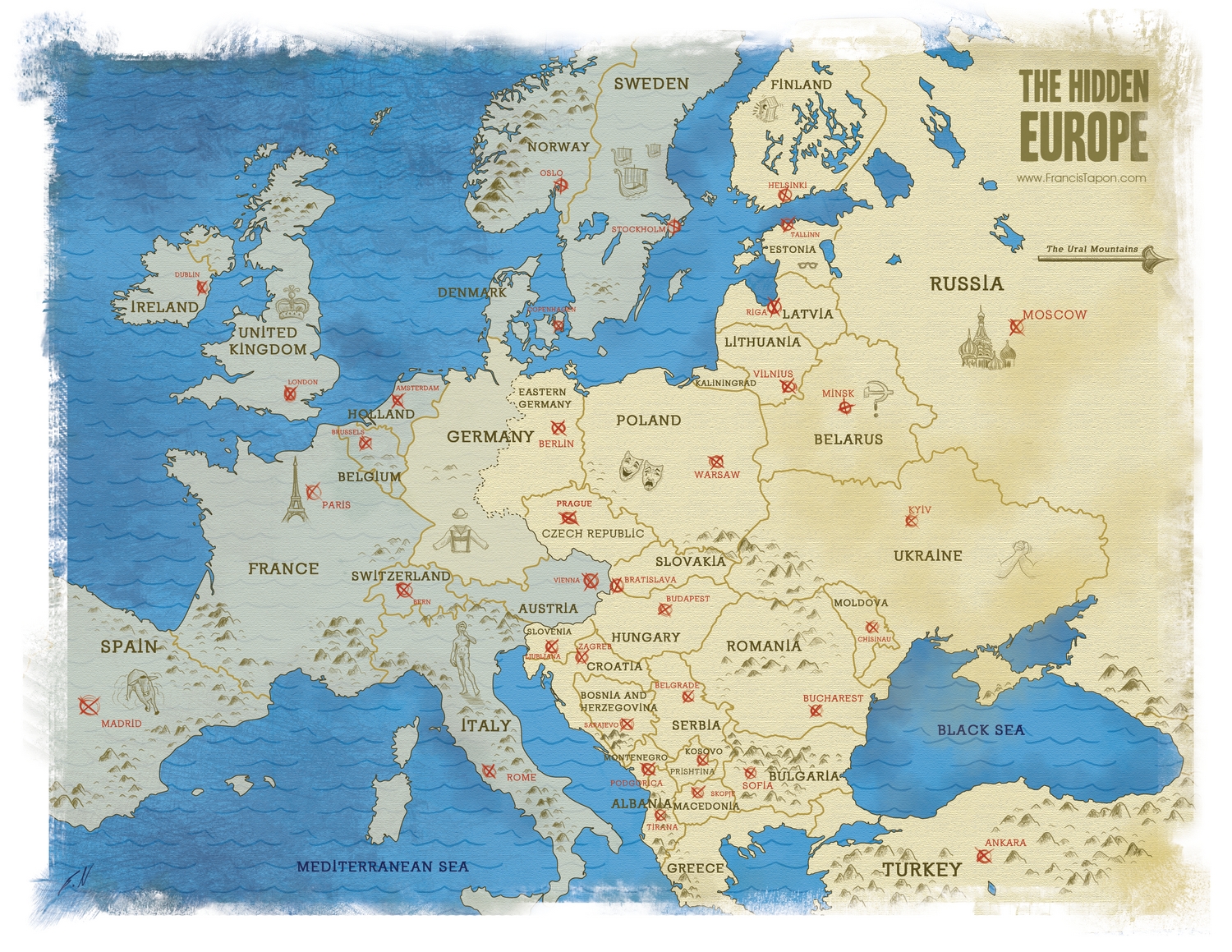
Move your mouse over image


Lost in Latvia

I spent much more time in Finland and Estonia than I had originally planned. I am not complaining. I had a great time, but I can't afford to spend two weeks in each of the 20 countries! That will take 280 days! I was budgeting 120 days, although I may take over 150.

Estonia casualty report

People may leave their hearts in San Francisco, but I left a bunch of stuff in Estonia:

  • Left my GoLite T-shirt.
  • Left my black T-shirt.
  • Lost my sunglasses.
  • Broke my camcorder when I fell off a canoe in Estonia (it works, although it always tries to eject the tape and I can't fix it in Eastern Europe).

If I keep this up, I will come back to the US naked.

I've lost most of my stuff, now I'm lost in Latvia. Luckily, I found out a bit about the country along the way.

Beat up Baltics

The Baltics are like that little nerdy guy at school who always got beat up for his lunch money.

Wait, that sounds like me!

Consider the history of the Baltics:

  • First the Danes ran the show.
  • Then they sold it to the German Knights of the Sword (don't they just sound like a bunch of bad-asses?), who established the Teutonic Order and ruled the land in the 14th century.
  • The Polish beat up Latvia for almost 100 years.
  • The Swedes wanted some lunch money too, so they snapped up Estonia in 1620.
  • After 20 years of fighting, the Russians conquered the place in 1721.
  • The Soviets handed over the Baltics to Germany after WW I.
  • The Estonians finally got their independence in 1920 and the Soviet promised never to invade again.
  • Less than 20 years later, the Soviets were back.
  • Then the Germans came back as WW II got started.
  • Believe it or not, the Estonians and Latvians gave flowers to the Nazis because they were the liberators of the terrible Russian Bear.
  • Then the Nazis showed their true colors and killed almost 500,000 Baltic folks in concentration camps. They also imposed their ugly language and did all those nasty things that Nazis do.
  • Stalin took over after WW II and picked up where Hitler left off: 250,000 were deported Siberia.


Sometimes I am frustrated that we have to choose between two idiots: George Bush and John Kerry.

But think about the Baltics: they had to choose between Stalin and Hitler.

Wouldn't that make you want to stay home on election day?

In short, since they started the Baltics have been beaten like a rented mule.

The 2 million person chain

On Aug 23, 1989 about 2 million Baltic folks literally joined hands and formed a human chain that stretched a whopping 650km. That's about 400 miles. That eventually led to the Soviets letting the beat up nerd go (and they just killed a few people on their way out).

Roaming Riga

That's what I learned from the Museum of Occupation in Riga, Latvia. You know your country's history is bit rough when you can devote an entire museum to all the jerks who have occupied your land.

Riga is a beautiful city with an old city that is bigger and better than Tallinn. Charming alleys, cobblestone streets, and quaint cafes litter the capital of Latvia.

By the way, like Finland, Latvians aren't afraid to elect a woman as their president. In 1999 Vaira Vike-Freiberga became the first woman to head a former USSR state.

I will try to not leave anything in the remaining Baltic countries....

July 21, 2004


Loving Lithuania

Lithuania doesn't suck

Everybody I talked with, especially in Latvia and Estonia, gave me the impression that Lithuania was the ugly sister in the Baltic trinity.

I met one Lithuanian in Finland who said that Latvians have a saying, "You're as dumb as a Lithuanian."

Demonstrating their profound originality, the Lithuanians have their own saying, "You're as dumb as a Latvian."

This dumb Lithuanian that I met didn't impressed me when she was "surprised by how many black people there are in Finland."

I said, "What black people?"

I talked with one black guy from DC who had been living in Finland for 8 years and he said his mom asked, "So are there any other brothers in Finland?"

He answered, "Yeah, there's another one. We're good friends."

So when this Lithuanian said with such disdain that there were so many blacks, I started believing the Latvian expression.

However, when I finally arrived in Vilnius, the capital of Lithuania, I was blown away by its beauty, history, and grace. The streets are enchanting and the architecture is spectacular. It's bigger and more stunning than any other city I've seen in the Baltics. Indeed, it's one of the best cities in Europe.

OK, the city is great but you still gotta wonder about the Lithuanians themselves...

Lithuanian logic

Some credit the Lithuanians with causing the collapse of the Soviet Union (they were the first Baltic country to challenge the Russians in the late 1980s). However, at their first democratic elections in 1992 they promptly voted in the ex-communist leader. That makes sense, right? Maybe to the Lithuanians.

Lithuanians are stubborn

About 100km west of Vilnius is Lithuania's second city: Kaunas. This is the Town That Was Just Not Meant To Be.

Founded in the 13th century, Kaunas has been reduced to ashes an amazing 13 times before WWII. And, as you would expect, it received yet another pummeling during WWII.

Why the residents don't get a clue and just give up on their idea of having a town in that location, I just don't know. Forget about guys, it's just not gonna happen!

But no, there are 415,000 stubborn denizens in Kaunas today, eagerly awaiting the day they can rebuild their city for the 15th time.

But there's two reasons you should visit Lithuania's beautiful capital and white sand beaches now and not later:

1) Over here, U.N. inspectors!

A terrifying arsenal of decomposing chemical weapons could wreak damage to the coast of Lithuania - and poison the entire Baltic Sea. About 40,000 bombs and mines lie on the seabed 70 nautical miles off Kaipeda where Soviet forces sank German ships. I ate some fish here while I could.

2) Coming soon to Lithuania: Chornobyl II

Lithuania, the most nuclear power-dependent country in the world, gets 80% of its electricity from the plant near the Belarus border. Experts rank it among the world's most dangerous nuclear installations. As Scotty on Star Trek would say, "Captain, I don't think I can hold her together much longer, she's gonna blow!"

It's not the first time Belarus has an unstable nuclear power plant on its border. Chornobyl, in Ukraine, blew up in 1986 and most of the nuclear debris landed on Belarus. Given the winds, the same will happen if Lithuania's power plant melts down. Real estate agents in Belarus have a tough sell.

Despite the EU spending $250M in the last decade to improve the plant's safety, it's still not good enough. The EU now wants to completely shut it down, but doing that costs a staggering $3.5 billion!

Given that Lithuania's annual tax revenues are a paltry $1.5 billion (and they have $6.5 billion in debt), there is no way they're gonna pay for it. Maybe Belarus will pay...

Into Belarus

Speaking of Belarus, that is my next stop. I excited because this country is almost impossible to get into. So it's gotta be good, right?

Um... I'll find out.

July 21, 2004


Mixed up in Macedonia

I’ve never met so many nice people who have so many enemies.I took the bumpy overnight bus from Albania and they dropped me in the middle of nowhere in Macedonia at 2AM. Although I could have stayed in a hotel, I setup my tarp and camped outside instead. I woke up at 5AM to take the bus to Lake Ohrid, Macedonia.

I’m not talking about the Albanians anymore, now I’m talking about the Macedonians. They’re tied with the Albanians for being the nicest and warmest people in Eastern Europe. Yet their four neighbors each have a reason to hate the Macedonians.

1) ALBANIANS dislike that Macedonians don’t let them setup Albanians schools in the Macedonian towns where Albanian is the dominant language. They feel like second class citizens and started a mini war over it August 2001.

2) KOSOVARS don't like Macedonians who resent them for being refugees in their country.

3) BULGARIANS refuse to recognize the Macedonian language. They claim it’s basically Bulgarian.

4) GREEKS despise that Macedonians call their country “Macedonia.” They say it implies territorial claims on northern Greece.

It’s amazing that this tiny country of two million nice people hasn’t been crushed yet.

The Bulgarian issue is stupid. Bulgarians should be happy that at least one other country on the planet speaks something they can understand.I had a fascinating conversation with this archeologist. He discussed the tension that exists between Macedonia's neighbors.

But the Greek point is hilarious. Greece forced Macedonia to call their country FYROM (Former Yugoslav Republic of Macedonia) so they could get in the UN. After the USA and some EU countries recognized FYROM, Greece imposed an economic embargo against Macedonia a closed its Thessaloniki port to trade.

When one American was crossing the border to Greece, the belligerent border asked her where she was coming from.

She said, “Macedonia.”

“No!” he shouted, “You’re coming from Skopje and NOW you’re in Macedonia!”

All this wasted energy because the Greeks don’t like the name of the Macedonian country. Don’t these guys have anything better to do?

Where is Macedonia?The archeological site has a great view of Lake Ohrid.

That’s a tricky question and that’s exactly what the Greeks and Macedonians are bickering about like a bunch of 6 year olds.

Today Macedonia is an independent country. But Macedonia is also in Greece. Greece’s northernmost state is called Macedonia, just like America’s is called Alaska.

So will the real Macedonia please stand up?

They’re both right. As usual in the Balkans you have to go a few thousand years back to get to the root of the problem.

Alexander the Great was really called Alexander of Macedon, because he was from the nation of Macedonia. When Alex was a teenager Macedonia was both in today’s Macedonia and Greece’s Macedonia. That’s right, ancient Macedonia is now split in two, with one part in Greece and the other in Macedonia.

Of course, by the time Alexander of Macedon was in his late 20s he managed to stretch Macedonia deep into Persia. But luckily today nobody in the Middle East is calling their country Macedonia.

Greece contends that since Alexander of Macedon was born in the 4th century BC in Pella and Pella is today in Greece’s Macedonia, then they are the true Macedonia.

But does that mean the Greeks are right? What if leaders before and after Alexander were born in towns that are in today’s Macedonia? Does that make the Greeks claim wrong?This small church has a spectacular location on the edge of Lake Ohrid.

The answer is: WHO CARES?! THIS IS ALL SO STUPID AND CHILDISH!

It’s incredible that grown men waste their time on such idiocies.

A close analogy is if the state of California decided to cede from USA and become an independent country. They would probably call the country California. Logical, right?

But then imagine if Mexico flipped out because they have a state called Baja California (which they do). Imagine Mexico refusing to let California into the UN and forcing us to call ourselves the FUSSC (Former United States State of California)? And then placing a trade embargo against us? And lecturing peaceful tourists who cross the border about where the “real California” is?

That's what's happening here. And I know it's funny, but believe it or not, it's a BIG DEAL here.

So who is the bigger baby in this fight? The Greeks. Why?

First of all, they started it. OK, that’s a pretty childish thing to say, but it’s true.

I wonder if the Greeks would have had such a big problem with the Macedonian name, if Macedonia was packed with 50 million hot-tempered Serbs? The trigger-happy Serbs love having an excuse to punch anybody's face in. But it's not fair to blame the Greeks completely.With few tourists in Macedonia, I had to take self portraits with the timer.

Macedonia shares a tiny bit of blame for being stubborn. They could have given in and just changed their damn name. After all, it’s just a name. I told this to my tour guide in Macedonia’s National Museum in Skopje (the capital). He bristled and said, “But we can’t, it’s who we are.”

“I got a better name for you,” I told him. “Roman Empire. Change it from Macedonia to Roman Empire. After all the Romans were here too.”

He smiled, “But then we might get Italy angry at us.”

“Well then, how about calling your country ‘Greece Sucks’?”

He laughed

Macedonia sliced and diced

I asked my thoughtful and patient tour guide, “Macedonia was much bigger just 100 years ago, so what happened? Who let out the air?”I rented a bike to go partway around Lake Ohrid. I snapped this picture when I feeling a bit artistic.

The Turks ruled the Balkans for 500 years (except for Montenegro). In 1912 the natives had enough. Generals from Bulgaria, Serbia, Montenegro, and Greece conspired to overthrow the Turks. Weak and poor Macedonia wasn’t invited to the secret party.

The four generals succeeded and the Turks were out. Now they needed to divvy up the spoils of war: Macedonia. Only Montenegro didn’t a chunk because it didn’t share a border with Macedonia. Even weak Albania got a piece of Lake Ohrid because they struck a deal.

Although the Macedonians fought hard in the Balkan War thinking that they would get their independence and original borders, they were bummed to find out that the greater powers had sliced and diced their country into less than half of its original size.

Today, Macedonia’s neighbors would love to have another bite. Here's what is left.

Lake Ohrid

Lonely Planet puts Macedonia’s Lake Ohrid in its Top 10 list of things to see in Eastern Europe. UNESCO has it on its World Heritage List. It’s the deepest lake in the Balkans (294 meters/yards) and one of the world’s oldest. Clearly a must-see site if you’re near.

I had ultra high expectations and was slightly disappointed. Without a doubt, it’s a large and spectacular lake. Maybe I was expecting to see waterfalls flowing with milk and honey.Not sure which picture is better, but I like the one above this one better.

I rented a bike and almost got to the top of Galicica National Park which touches the lake. I rode down on an awesome dirt path all the way down and practically destroyed the bike.

The old town of Ohrid is precious with its narrow, steep cobble stoned streets, and many churches set on the edge of the lake. It's pretty awesome.

I stopped Bitola to see the impressive Heraclea ruins (Macedonians founded it in 4th century and Romans took it over later).

Hanging out with teenagers

A friend in San Francisco introduced me to Audrey, an American living in Macedonia. Audrey then introduced me to Zlatka, a 16-year girl living in the mountain town of Krushevo, Macedonia. Zlatka’s family loves having visitors and Zlatka offered to let me stay with her family a couple of days.

Zlatka spoke excellent English, although the rest of the family couldn’t. They were incredibly hospitable and warm. As I mentioned, Macedonians are tied with the Albanians for being the friendliest people in Eastern Europe.

That statement would perturb the Macedonians, because they hate the Albanians. What’s truly sad is that they’re taught to blindly hate the Albanians at such a young age. I went on a field trip with Zlatka’s school and spoke with many of her teenage classmates. Their utter loathing of Albanians was so absolute that it was scary.This little girls were a bit surprised to see some guy from California biking by their house. I was on my way to bike up that mountain behind them. I went down some dirt paths with a bit of improvising (I had to carry my bike over some extremely rock and rough areas).

Up until now I assumed that most of the Balkans equated Albanians with desperate immigrants. But these teenagers argued the opposite. They said that all Albanians are very rich.

One claimed, “They have at least 10 children. Two to send foreign countries to make money and send it home, three to send to wars, three to stay home and help with family, and two to be criminals.”

Another chimed in, “They have the best jobs in Macedonia and favor other Albanians. They are buying our land. They want to take part of Macedonia. They’re rich. And they all wear white hats.”

I asked him, “Have you been to Albania?”

He looked down to the ground, indicating no.

I told him, “I just was there a few days ago. Trust me, Macedonia is richer than Albania. You guys all need to go to Albania and learn a bit about their culture and country.”

The response was intense, “Albanians HATE Macedonians! They would KILL me there! I never ever want to go to Albania! I have absolutely no interest!”

Feeling the AlbaniansZlatka (right) is a 16-year old who invited me into her family's house in Krushevo. She's walking with her best friend, Kate.

While Zlatka and I were waiting for my bus to Skopje, I saw a hansome man with sandy blonde hair and hypnotic blue eyes. "There you go, Zlatka, there's the man of your dreams." She had told me she dreams of finding her perfect Macedonian man. I thought I had a good candidate.

She choked. "He's Albanian," she said.

I was stunned. "How do you know?"

"He's done some work for my family. He's a carpenter."

"So if you didn't know that," I asked, "Would you have been able to tell he was an Albanian just by looking at him?"

"Oh yes, of course!"

"How?"

She looked at me intensely, "You can just feel them."

Really? I had to try. I closed my eyes. Relaxed my mind. I listened to my feelings.

However, all I could feel was Zlatka's stubborn and senseless hate.
Zlatka and Kate
Once again, the paradoxes in the Balkans sent my head spinning. My brain got completely mixed up in Macedonia. How could such lovely, friendly, and intelligent teenagers hate so blindly and absolutely?

Audrey later told me that the kids throughout the Balkans are taught to hate certain people from an early age. For example, Albanians are taught to blindly hate the Serbs and vice versa. These kids learn to hate from their parents and grandparents. They pass down the prejudices just like white Americans a hundred years ago taught their kids that blacks are the scum of the earth. Of course, even today some Americans still haven’t read the memo that African Americans are good people too.

Tragically, the Balkans can’t shake the vicious cycle of violence and hate. And the future looks bleak as long as today’s teenagers have such burning and senseless hatred in their hearts. They inability to forgive and move on hampers their future.

The Balkan time bombKrushevo is a small, quaint, hilly town with horse drawn carts going through the streets throughout the day.

The first Macedonian I met was a wise, yet young archeologist who had lived in England for a couple of years. He ominously told me, “Since I’ve been back, I feel the tension rising here.”

The Macedonian government finally gave into Albanian pressure to have public Albanian schools in Macedonian cities where Albanians dominate (like Tetovo and Gostivar). But now the Albanians want Albanian Universities in Macedonia.

One politician offered a sensible solution of giving Albania the areas of Macedonia with over 85% Albanian presence in exchange for the territory around Lake Ohrid that used to be part of Macedonia. The politician’s career is now over.

People in the Balkans are so entrenched in their views, their tolerance for difference is so low, their nationalism (and ethnic pride) is so high, their view of history so skewed, their ability to forgive so low that it’s clear why they’re always fighting each other.

What’s the solution?I joined Zlatka's high school class on a field trip to a church and sanctuary.

The archeologist told me, “What we need are jobs and a good economy. When people are working and making money, they don’t have time to think about the past. We’ll start looking forward instead of backward.”

He’s right. Tito ruled Yugoslavia for 40 years and was the most beloved dictator I’ve ever seen. Everyone in Yugoslavia prospered under his rule. Ethnic tensions were replaced with cooperation as Yugoslavia traded vigorously between the Communist East and Capitalist West. He played the delicate game so brilliantly that the people thrived under him.

However, the vast majority of people I talked with in the Balkans (especially the young people) said the future is bleak and they just want out.

A humble church in Skopje

I left southern Macedonia via Prilep and arrived at Skopje, the capital. A massive earthquake in 1963 leveled most of Skopje. They did a lousy job rebuilding it, but they have some nice mosques and churches.

The Church of Sveti Spas isn’t a spa, but it’s the most interesting building around. In the 17th century the Muslim dominated town had a law that no building could be taller than a mosque. These enterprising Christians wanted a nice high vaulted ceiling so they came up with a sensible solution: put half the church underground!It was a hot day, especially for the uphill walk back. The Macedonians and the Albanians were the friendliest people of Eastern Europe.

That’s right, it’s a half-buried church. The steeple isn’t high so they didn’t get in trouble with the ruling Turks and the Christians were happy to have a high ceiling.

What’s ironic is that today a massive cross, complete with bright lights, is perched at the summit of the mountain that overlooks Skopje (and all its mosques).

Teaching three classes in Macedonia

Audrey, Assistant Head of Nova Schools, invited me to teach three high school classes. As you can tell from my emails, I have an ability to talk forever, so I agreed.

The first class was a writing class. I focused on how to do travel writing. I gave them a few hints, but told them if they wanted some real tips they should sign up for my $295 workshop in San Francisco. No takers.

The next two classes were geography classes. They asked me questions about the 60 countries I've visited. I told them that everybody in America is extremely rich, everyone in Africa is hungry, and all the men in Albania wear white hats.

I really enjoyed teaching the classes. I suppose it helps that cute teenage girls were listening to my every word.

Field tripAudrey and I overlooking a small eastern village in Macedonia during a school field trip. She's the assistant principal at the school.

Audrey invited me to join her 190 high school students on a field trip to eastern Macedonia. Packed in four buses, we visited a few churches, small towns, and a waterfall.

The highlight was tossing a football with Audrey in a small town square. Macedonian girls stood in awe seeing a woman toss a perfect spiral.

When we left a group of boys followed me all the way to the bus. They couldn't believe a Californian was visiting their small town. I had to show them my CA driver's license to prove it.

Setting my sight to Kosovo

I didn’t want to go to Kosovo, because the region is still unstable. But the Balkan puzzle was incomplete without that crucial piece.

Macedonians told me that the worst of the Albanians were in Kosovo. That made me curious. I had heard the Serbs give their two cents about the war and it was only fair to hear what the Kosovars had to say. Moreover it would be just cool to camp in Kosovo.

September 30, 2004

I'm not sure why I ended up in this picture with all these female school teachers and administrators, but I'm not complaining. Audrey and her school kids after our field trip to the waterfall in the background. All the kids spoke English well because it Nova Schools is a bilingual school. I taught three classes at the school and the kids actually pretended to enjoy it!

Ivan was the smartest person I found in the Balkans. He's the only native who was able to objectively look at his own country and history. He could analyze Balkan history dispassionately and arrive to the most insightful conclusions I ever heard about the region.A self portrait of the massive (and controversial) cross that looms over Skopje, the capital of the Macedonia. The Muslim population is not too happy about it, but it's a worthwhile hike to the summit.

These ladies are cooking up a traditional Macedonian sauce made of red peppers called ajvar.


Marauding Moldova

"You must leave Moldova by midnight on Oct 14," the Moldavian consulate official told me in French.For a brief lesson on Cyrillic characters, see the bottom of the story on the right. This is DOMCOBETOB, pronounced Dom-sovetov. Dom means House. So it's the Soviet House. And there's Lenin to confirm. This is Tiraspol, the Russian controlled part of Moldova. It's tricky to get here and not much to see, but it was a great adventure.

"And if I don't?" I wondered aloud.

"You will have big problems," she assured me with a smile.

I wondered if Moldovans learned from their Romanian vampire neighbors and practiced impaling tourists who overstay their welcome.

My $30 transit visa gave me 3 days to get through Moldova and into Ukraine. The consulate is conveniently located at the border so they process the visa in minutes. EU citizens pay almost half the price as Americans so I whipped out my French passport to snag the discount.

Border crossing paradox

Why is it that the less desirable the country, the more difficult it is to get in it?

When I entered into Finland, Czech Republic, and Austria I could time the border crossing in seconds. However, when I entered Belarus, Kosovo, and Moldova I had to measure the process in hours.

You'd think that elite countries would be highly selective about who comes in and that undesirable countries would let any jackass in. Not so.

Another divided country

Another cramped bus, another little known country, another worthless currency, and another unpopular language. After 20 countries in 5 months, I'm used to this and still loving it! :-) I am also getting used to encountering divided countries:

  • Finland (co-existing with Swedes)
  • Estonia (with Russians)
  • Various Balkan nations (with Albanians)


Moldova is one of the 23,473 little countries that came out of the former Soviet Union.

I could tell Americans that Moldova is located between Romania and Ukraine, but I might as well tell them it's between Togo and Mali, because most Americans have no clue where Romania and Ukraine are.

Moldova is yet another Eastern European nation that struggles to make its ethnic majority (Moldovans) get along with a significant ethnic minority (Russians). The Russians weren't always so significant in this country.

Moldovan football

Romania and Russian have been playing political football with Moldova for the last few centuries. Control of the region has traded back and forth more times than a stock on the New York Stock Exchange floor.

Most Moldovans hate the Russians. Why? Because they're bored and have nothing better to do.

But also because:

  • After WWII the Russians imposed their Cyrillic alphabet on the Moldovan language (which is a dialect of Romanian, sounds like a Romance language, and uses Roman characters).
  • Russian became the official language.
  • In 1949, Russians deported 25,000 Moldova to Siberia and Kazakhstan, which is never fun.
  • During the next couple of years Leonid Brezhnev, then first secretary of the central committee of the Moldovan Communist Party (and later leader of the USSR), deported 250,000 Moldovans.
  • To dilute the Moldovan population further, they gave incentives for Russians to settle there.


Yes, this ethnic cleansing at its finest.

Homo sapiens did it when we were hunting down the last Neanderthals.

Humans, like all living things, seek to reproduce themselves while stamping out the competition. The more different someone is, the more we seek to obliterate them. Which brings me to the...

Easy four step ethnic cleansing plan!

In case you want to do some ethnic cleansing in your neighborhood, here are the four steps for you budding despots:

1. Conquer a territory.

2. Expel or kill the rebellious indigenous population.

3. Have your nation overwhelm the land through massive immigration.

4. Take away their contraceptives so your people reproduce fast.

If you do it right, in a couple of generations you will have transformed the language and ethnicity in the region! Voila! Instant empire expansion!

Alas, it almost never works. Those feisty indigenous people are just too hard to stamp out. The Serbs tried to follow the Four Step Ethnic Cleansing Plan, but NATO crashed their party.

Israel is doing its best to take over Palestine by following the Four Step Plan, but has been consistently a bit weak on executing Step 2. The Israelis need to more ruthless if they want to pave the way for a Greater Israel. Constructing a few concentration camps for the Palestinians might do the trick.

The Palestinians would love to do some of their own ethnic cleansing and get rid of the Jews, but they need a lot of work to fulfill their fantasy. But at least they have Step 4 down pat.

Sadly, as long as we have bigoted and unforgiving people, we'll have idiots trying to cleanse each other. Fortunately, it's hard to execute the Four Step Ethnic Cleansing Plan. Off the top of my head, the only examples of "successful" ethnic cleansing are:

  • Nazi Germany's cleansing of the Jews (a few thousand are left in Eastern Europe compared to the original six million).
  • The Spanish and Portuguese cleansing of South and Central America.
  • The American cleansing of the Native Americans.

The last two examples "succeeded" mainly because the Old World inadvertently used biological warfare (through small pox and other diseases). That's hard to do today especially since we can't find the weapons of mass destruction in Iraq.

It also helped that the Old World had overwhelming technological superiority over the indigenous peoples. This helped finish off the few that didn't succumb to the bio-weapons.

Nazi Germany "succeeded" partly because of technological superiority, but mostly because they're just organized Germans. They're just good at getting things done.

Ok, back to Moldova

Believe or not, that diatribe is relevant to Moldova today. The Russians aren't efficient like the Germans. They left way too many stragglers behind and managed to only overtake one dinky region in Moldova.

Russians only make up 27% of the country overall. So like the Albanians who dominate small regions of Macedonia and Serbia, these Russians don't want to be marginalized into second class citizens.

Today Russians and Ukrainians make up over 50% of population east of the Nistru River. This tiny region in this tiny country is called Transdniestr.

Ethnic Ukrainians and Russians are concentrated in that region.

Like the Estonians, the Moldovans have reinstated their language, while the Russians still cling onto theirs. The bitter hate between them erupted in 1992 when a bloody civil war started along the river that divides them.

Crossing the river

Like Montenegro, Transdniestr is a tiny nation within a nation. Montenegro is within Serbia, but they use the Euro instead of the Serbian Dinar. Montenegro is nearly completely autonomous.

Transdniestr is similar. The Russians living there have their own currency, police force army, and its own (unofficial) borders. It was relatively painless to cross these borders, although I had to pay a tax for a one day visa and register with the military in two different places. The border is heavily policed. With the Lenin's face still ubiquitous it's clear that, like Belarus, Transdniestr is one of the last bastions of the silly Soviet system.

Inflation is rampant and the local currency is next to worthless. It all started in 1994 when the separatist government introduced the Transdnistran Rouble so they could be free of the Moldovan Lei. Inflation exploded and the rouble quickly added more zeros than Bill Gates's bank account.

Eventually a million roubles could barely get you a cup of coffee. So they slashed six zeros in 2001 and today inflation has cooled, but the economy is still in the toilet.

For the average person economic conditions are abysmal. Wages are low and poverty is rife. About two-thirds are elderly and impoverished. They long for the good old Soviet days when the government gave them money just for being old farts.

Transdniestrn trail magic

The signs at the 1992 War Memorial in Tiraspol, the capital of the Transniestr region, are only in Russian. It was late and the memorial was deserted due to the cold temperatures. But then I spotted two women and I asked them to help translate. I had little hope that they could speak English, but to my surprise one could! Barely.

Moldovans, like Belarusian, usually have one of two extreme reactions when I open my American mouth...

1) They break a wide smile: They are curious why a lone Californian is trotting through their unpopular country.

2) They act like I just told them that their mother is a whore: They glare at me, slowly squint their eyes, turn their head, and walk away. They don't even try answering my question. They're so rude it's comical.

It's rare that I get a ho-hum reaction.

Luckily, these ladies fit category #1. Within minutes they asked me if I wanted to join them for coffee. They offered to help me find a hotel and negotiate hard. They weren't satisfied with what the hotel was charging me (inflated "tourist prices"). Then they surprised me.

Alyssa, who is married and has two daughters, invited me to stay with her family. I was thrilled with another opportunity to stay with a local family. Such encounters are always highlights of any journey.

Alyssa served up a delicious late night noodle/potato/vegetable soup. The apartment in a 10 story building was humble, but functional. They have no hot water, but they do have gas. So I just heated up a pot of water, mixed it in a bigger bowl of cold water, and had a overdue sponge bath.

Don't call me Dostoevsky yet

Nobody in Alyssa's entourage could speak English well, which forced me to continue improving my Russian. Considering I've never taken a class in Russian, I've come a long way. I'm surprised how well I can communicate with Russians.

So how good is my Russian now?

I'm confident that I no longer speak like the Frankenstein monster. I'm much better. Nowadays I speak like Tarzan.

The Russian perspective

The Moldovans look at Russians like the Macedonians look at the Albanians: they're tainting the "purity" of their country. Moldovans dislike the Russians because they refuse to learn the Moldovan language and integrate with the rest of the population.

But I just like I went into Kosovo and Albania, I figured I'd hear the minority view. Russians aren't used to being second class citizens. But the Moldovans want to squeeze them out. The Russians believe that Moldova wants to unite with Romania (they share a similar language and culture). Meanwhile, the Russians have a natural affinity toward Russia. Today it's a stalemate with no end in sight.

The root cause of all this turmoil is the Russian's half-ass ethnic cleansing a half a century ago.

So the lesson folks is that if you're going to cleanse somebody's ass, make sure it's a deep cleaning.

Visiting Chisinau

I briefly visited Chisinau ("Kish-i-now"), the capital of Moldova. It's nothing special, but it's not terrible either. The crowds in the streets astounded me.

Why is it that no matter how shitty the economy, there's always people buying stuff on the streets, yapping on cell phones, wasting discretionary income on cigarettes, dyeing their gel-filled hair, and frequenting overpriced cafes?

The three lane highway to hell

With my visa soon set to expire, I set off to Ukraine on hell's highway. Moldova has a curious highway design: a three lane highway.

The two outer lanes go in opposite directions. The middle lane is a free for all. Use it for passing, but nobody has right of way. It's a constant game of chicken. When you're blasting down the middle lane, there's nothing stopping anyone going the opposite direction to challenge your position.

It's times like these that I just sit in the back of the bus and find God.

The language that teases

When I entered the Russian-controlled territory of Moldova I saw Russian written everywhere. This will prepare me for Ukraine and reminds me that it's a language that teases me.

Russians, Ukrainians, Bulgarians, Macedonians, and Serbians use the Cyrillic alphabet, which tortures those of us who have grown up on the Roman alphabet.

Part of me is happy that I can recognize some characters, but other times I just wish it was gibberish like Arabic and Chinese characters. At least when I go to Japan, I don't even try to read the signs. There is no hope.

But when I walk through a country that uses the Cyrillic alphabet I feel a glimmer of hope. Like when I travel through Italy or Brazil, I try to read the signs that have my trusty roman characters. This works in Italy, Brazil, France, and Spain because nearly all the letters sound like the English version.

For example, when you see "farmacia" you can say the word out loud and realize that it sounds like "pharmacy."

You'll naturally do the same when you come to Ukraine. Unfortunately, you'll be completely lost because many characters may look the same, but the pronunciation is completely different. As a result, you will go clinically insane.

Here's a crash course. I'll show you a letter in Cyrillic and then show you the equivalent sound in English.

(For you smarty pants who know how the Cyrillic characters really look, forgive me that I'm not using them. But most people who are on this list are unable to display the true Cyrillic letters, so I'm approximating how they look to the untrained eye.)

Cyrillic Alphabet = English Alphabet

B = V

r = g

j = y

H = N

H (with a slanted connecting dash) = i

n = p

p = r

c = s

x = kh (like "ch" in loch)

U = ts

W = sh

3 = z

Perhaps it still hasn't hit you as to why these slight changes can drive you bananas, let's play a game. I'll write the word as you might see walking through the street, and you try to guess what it means. Then I'll show you how it sounds if you were to pronounce it, and then what it means.

Let's start with my favorite. It's the one you see everywhere: PECTOPAH.

What the hell is a PECTOPAH? Use my handy cheat sheet above, and you'll realize that the P sounds like an R. The C is like an S. So instead of "PEC" say "RES". For the last 3 letters: remember the P is an R, and the H is an N. So: RES-TO-RAN. Restoran. That's right, restaurant.

The Bulgarians make it a bit easier on you, they write PECTOPAHT; hence, RESTORANT.

Whew!

Here's a few more:

bAHK = "baank" = bank

bAP = "bar"

nAPK = "paark" = park

TAKCH (slanted connector on H) = "Taxi"

Cnopt = "Sport"

KOMnyTEP = "Compooter" = Computer

Cynep = "Sooper" = Super

So "cynep mapket" is "super market"

3y = "Zoo"

nACnopt = "passport"

nPECCA = "Pressa" = Press (i.e., newspaper stand)

And one of my favorites...

rA3 = "Gaz" = Gas

Isn't this fun! So my greatest pastime when I'm in countries that have Cyrillic alphabet is slowly reading their signs. I mouth it out and then realize what it means. It's a tedious but fun process, especially when you get it!

Once I cross the Ukrainian border I'll have plenty of time to practice and I'm sure it'll get old quick.

OK, I gotta go, it's getting late, and I'm running out of rA3.


October 19, 2004


Moving to Montenegro

I wrote this article in 2004. I celebrated my birthday here five years later because it's my favorite place in Eastern Europe.

Captivating KotorMarcos and I woke up at 6AM to hike up the mountain while the temps were still cool. Here I'm passing the ruins of a fort above Kotor.

I can think of no higher compliment I can pay a town than to say, "I want to buy a house here."

That's what I said when I walked through the streets of Kotor, Montenegro.

From an interior with Alpine-type scenery to deep canyons, coastal fjords, and a sparsely vegetated and limestone mountain range that plummets down to an azure Adriatic sea, Montenegro has got the works. But it was Kotor, a town which lies in the largest fjord in southern Europe, that stole my heart.

The highlight of my Eastern European trip: Kotor

My guidebook says, "Kotor is a big secret." No kidding.

Kotor is a small town with a population of 25,000, and it lies on the Montenegrin coast in the southern Adriatic. It stands at the foot of the Lovcen massif, at the end of the deep, rugged Bay of Kotor.

Tiny Kotor has all the features I love in a typical Venetian town: narrow sinuous streets, little picturesque shops, antique monuments, and enchanting plazas. But it has something that Venice and Dubrovnik don't: massive mountains towering all around the city which is set at the end of a triple bays. And it's a lot cheaper too!

It's got a cool location. OK, so Kotor doesn't have the canals of Venice, but maybe global warming will change that.

Plus, you have the thrill of knowing that the Serbs might want to invade at any moment.

Kotor's history A bit later, we made halfway up the mountain. The fjords of Kotor were impressive.

Locals call it a 6th century town, but Illyrians lived here in the 3rd century BC. Maybe I'll share with you its rich history some other time, but for now just enjoy the pictures.

Oh yeah, and there's more to Montenegro

You know you're small when Estonia is 3 times bigger than you. But there's still a lot to see in Montenegro, although everyone told me to skip Podgorica (the ugly capital) and so I did.

Marco and I saw Herceg-Novi, which an old walled city set on a steep slope that ends with beaches. It's not a bad pit stop after crossing the Croatian border (which is a pain because you have to walk across the border since these neighbors still haven't kissed and made up).

Man-made island, built over 500 yearsAs the temps soared, Marcos shed his shirt. Here he's nearly at the top of the mountain.

When Marco and I were 30km outside of Kotor we passed Perast, a small waterside village. Although the town is cute, it's the two islands next to it that draw your attention. They are so close to the sea level, they look artificial. One is. And the story of how the Montenegrins built it is remarkable.

The locals created the island called Lady of the Rock by dropping stones on the site every July 22. It eventually dawned on someone that this sure is a slow way to build an island.

Therefore, a few hundred years ago they loaded 87 captured ships with rocks and then purposefully sank them onto the site. That certainly helped their progress.

It took 550 years, but there it is, and a man-made island built before earth moving equipment.

Original capital of MontenegroMarcos and I met Alex, a local who has a charming restaurant in the mountains.

Cetinje, perched on a high plateau above Kotor, is the old capital of Montenegro, and is the subject of songs and epic poems. The Montenegrins are proud that they were the only country in the Balkans that never fell under Turkish rule.

The town isn't that great, but the drive/walk up from Kotor is spectacular.

Budva's beach

Budva is Montenegro's top beach resort. It also has a walled town that was completely rebuilt after two earthquakes in 1979. Budva is much more polished than Kotor and has the beaches that folks in Kotor have to drive 40 minutes to get to. But it lacks the majestic

mountains that encircle Kotor and the inexplicable charm of that city.

DisclaimerMarcos with the Kotor's mountain behind him.

Before you all buy the next plane ticket to Kotor (Tivat is the nearest airport), realize that I'm a sucker for quaint Venetian towns. I'd guess that most people would go to Kotor, spend a couple of hours roaming around the town and conclude, "Yeah, it's nice. But not that great."

Most would prefer Venice or Dubrovnik because they are much more grandiose than poor little Kotor. But I treasure finding little overlooked gems, so I appreciate Kotor more than most.

And no, I did not meet some girl who is encouraging me to move there. On the contrary, the few girls that Marco and I met were not that nice. Despite the ladies, I liked the tiny town. I did run into a great business opportunity, but that's another story.

Therefore, I left with a bit of sadness, but I may return someday.

September 21, 2004


Sunset over Kotor Bay.

Most people when they think of Serbia-Montenegro they think of an ugly war torn region.

Think again. This is the magical town of Sveti, near Kotor.

The humble house that I would love to buy and fix up. It's the highest house in Kotor. The simple entrance into the house. Yeah, it needs work.

The view from the house is breathtaking. I could probably write a few books just looking at this.


A Promenade through Poland

Before I start my chronicle of my time in Poland, let's have a good Polish joke:Francis Tapon in Krakow, Poland

These two Polish guys rent a boat and go fishing in a lake. They are amazed at the number of fish that they caught that day, so one says to the other, "We'll have to come back here tomorrow!"

The other asks, "But how will we remember where this spot is?"

The first guy then takes a can of spray paint, paints an X on the bottom of the boat, and says, "We'll just look for this X tomorrow."

The other guy says, "You idiot! How do you know we'll get the same boat?"

I am smelling too many flowers

I crossed the Polish border realizing that I have been traveling for two months. So I was at the halfway point of my four month journey.

Then came the bad news: I am planning on seeing 20 countries and so far I have only seen 6.

See the problem?

This will trip will take more than 4 months.

So I will readjust my calendar on my web site this week.

Q: How do you get a one-armed Polak out of a tree?

A: Wave to him.

Poland in brief

Although Poland is one of the biggest countries in Europe, it's only about half the size of Texas. This explains why George Bush doesn't listen to what the Polish (or any of the Europeans) have to say.

Poland was founded in AD 966 when Mieszko I, Duke of the Polanians, adopted Christianity to get official recognition from Rome. They have been ardent Catholics ever since. There's a church on every corner!

It had its glory days for a while until the 17th century. At that point Sweden and Russia marched back and forth across the territory. Seven of its 11 kings were foreigners during a 200 year period. See, Iraq doesn't have it so bad....

In the late 18th century, Russia, Prussia, and Austria greedily conspired to carve up Poland. They systematically removed Poland from the map of Europe.

Then came the Nazis

Germans are efficient. This is great when they're making cars, dishwashers, and beer, but not so good when they're killing Jews.

There were over 3 million Jews in Poland before WW II. The Nazis managed to find and kill almost every single one of them. Today, 50 years after WW II only 7,000 Jews live in Poland.

Warsaw is underrated

I ran into a few Polish people before I got to Poland. They all told me to skip Warsaw.

I was about to do that, but since I had to go through Warsaw anyway to get to Krakow I figured I'd spend a day in Warsaw and confirm that it really does suck.

The good news is that that the Poles are wrong!

Unesco's has a World Heritage List which is made up of all the things on this planet that are cool and worth preserving.

In this trip I've seen many of the sights in each country I'm visiting. The list has never let me down. Neither did Warsaw's Old Town.

Old town

Over 85% of Warsaw was destroyed at the end of WW II. Half of its residents died. That's 700,000 people. No other Eastern European city suffered so much devastation.

The Poles rebuilt the Old Town of Warsaw precisely as it was. They did such a good job that Unesco awarded with its coveted World Heritage prize. But there's much more to see in Warsaw, so don't listen to the Polish, they don't know what they're talking about. Warsaw is great.

Did you hear about the latest Polish invention? It's a solar-powered flashlight.

Famous Polish people

OK, so I'm poking fun. Consider these famous Poles:

  • Nicolaus Copernicus: Told us that the Earth revolves around the Sun.
  • Frederick Chopin: Wrote a few piano tunes.
  • Roman Polanski: Polish director of Chinatown.
  • Pope John Paul II: His face is EVERYWHERE in this country.

Speaking about the Polish Pope:

A Polak saw a priest walking down the street. Noticing his collar, he stopped him and said, "Excuse me, but why are you wearing your shirt backwards?"

The priest laughed, "Because, my son, I am a Father!"

The Polak scratched his head. "But I am a father too, and I don't wear my shirt backwards!"

Again the priest laughed. "But I am a Father of thousands!"

To which the Polak replied, "Well then you should wear your shorts on backwards!"

The wonders of Krakow

So far Krakow wins my award of the best city on this trip! Put it on your list of must see cities! This spectacular city has the biggest Old Town in Europe and two interesting side trips: the Salt Mines and Auschwitz.

Wieliczka's salt mines

The highlight of the Salt Mines is a church carved from the underground salt. This place left me flabbergasted. One well-traveled Frenchman observed in the 18th century that Krakow's Wieliczka salt mine was no less magnificent than the Egyptian pyramids. But what the hell do the French know anyway?

It's hard to describe. You get to explore a subterranean world of labyrinthine passages, giant caverns, underground lakes and chapels with sculptures in the crystalline salt and rich ornamentation carved in the salt rock. Whimsical dwarves, inspiring religious statues, and haunting figures all carved from salt stare at you in the semi-darkness. It's been worked on for 900 years. Lick the walls for some free salt!

Auschwitz

I told a few Poles that I was going to Auschwitz. I was surprised by their response.

They had a twisted expression on their face and said, "Why do you want to go there? It's really depressing!"

I felt like replying, "Really? Darn, I thought it was going to be like Disneyland."

I know we Americans are stupid, but c'mon, are we really that dumb?

Part of me wondered if Poles wished they could sweep Auschwitz under the carpet and move on. But admission is free, so I went anyway.

Auschwitz was the most horrible concentration camp the Nazis ever made. German efficiency comes out in this ghastly killing machine. A train load of tightly packed Jews (and other victims) pulled right into camp. The Nazis quickly selected the fittest 25% to work to death for 11 hours a day on 1500 calories. Life expectancy was about 4 months.

The weakest 75% (including all the elderly, women, and children) on the train were immediately executed. The efficient Germans had to devise a way to kill them fast enough. So they were led to a chamber, told to undress, and told them they were going to take a shower for disinfection. They even had fake shower fixtures. They locked the doors and pumped in gas to exterminate 2,000 Jews in 20 seconds. Then the entire chamber would lift up like an elevator to the incineration chamber to cremate the bodies. Jewish prisoners would clean out the ashes of their brethren and then the Nazis would bring in the next batch of 2,000 Jews. A chilling invention and a sobering memorial.

What impressed me the most was the sheer size of Auschwitz. The biggest site is Auschwitz II, called Birkenau. It's enormous. A small city. It had to be because it could hold up to 200,000 Jews at a time and was constantly busy. They were in the process of expanding it when the Soviets pushed them out.

Again, don't listen to what the Poles say, visit Auschwitz when you go to Krakow.

Off to Slovakia

After Belarus, Poland was a culture shock. I was so used to being the only American for miles. Now tourists are everywhere. Businesses are service oriented. There is hot water.

I haven't been over 1,000 feet (300 meters) since I started this trip. All 7 countries are pretty flat. Finally that will change.

Now I go to the High Tatra Mountains of Slovakia. I will backpack there and then head to Bratislava, the capital.

As I mentioned, I need to speed things up. So I'll leave you with....

One last Polish joke

A Polak wanted to learn how to sky dive. The instructor then explained that he himself would jump out right behind him so that they would go down together. The Polak jumped from the plane and after being in the air for a few seconds pulled the rip cord. The instructor followed by jumping from the plane. The instructor pulled his rip cord but the parachute did not open. The instructor, frantically trying to get his parachute open, darted past the Polak. The Polak seeing this yelled, as he undid the straps to his parachute, "Oh, so you wanna race, eh?"

August 7, 2004


Roaming Romania

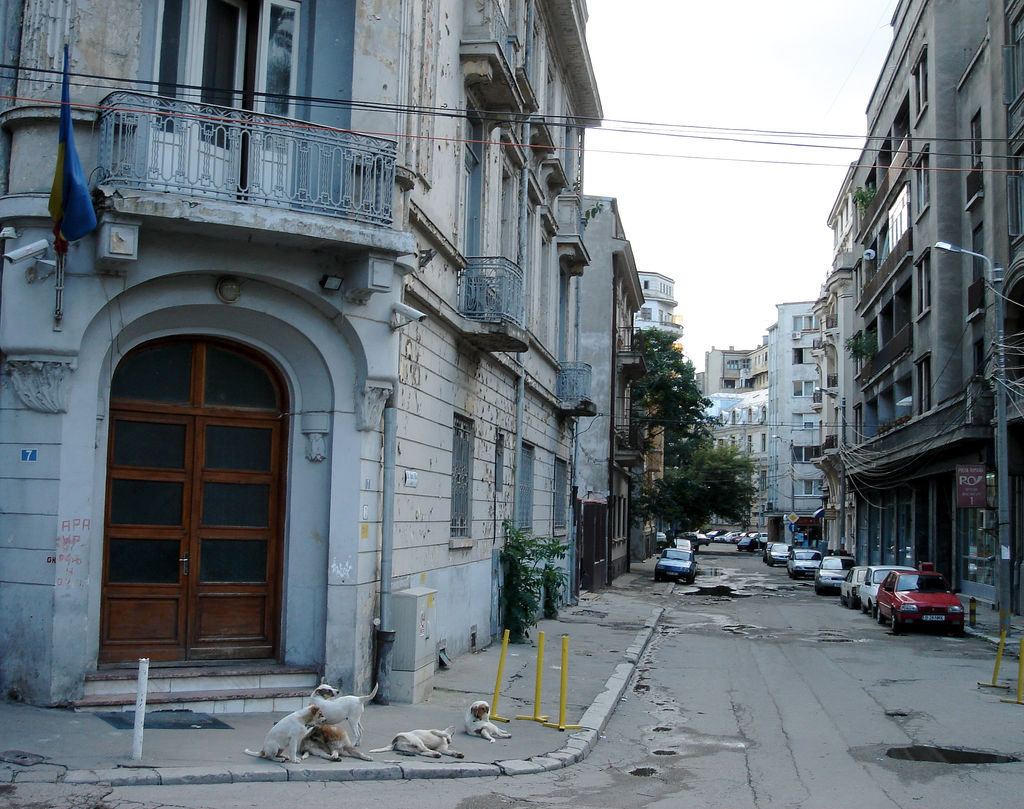
"Can I get across the Bulgarian-Romanian border by bus or foot?"Nope, this isn't Paris, but Bucharest is Eastern Europe's Paris.

"No," he nodded.

Huh?

"So, the only way to go to Bucharest is by train?" I tried to confirm.

He shook his head from side to side and said, "Yes."

Not globalized enough

Just when you think we've globalized, you find out that Bulgarians never got the memo that nodding is the universal signal for "YES" and that shaking your head means "NO."

That's right. Bulgarians do the opposite. This is confusing.

I spent hours wandering the streets of Sighisoara.

For example, I entered a restaurant and asked a waitress if I could see the menu. She shook her head and walked away.

Shocked by her rudeness, I turned around to leave.

She cried out, "Wait! I bring!"

"I'm sorry," I told her, "It's just that you seemed to say 'no.'"

"I know! I understand. I meant yes!" she said.

This made me wonder if Bulgaria has more date rape cases than the average country. After all, it's a country where no means yes.

Border issues

Which of these colorful figures in Sighisoara's clock tower comes out depends on the day of the month and the hour.

Tip to all you world trekkers: You cannot cross the Romanian/Bulgarian border by foot. I tried, but they wouldn't let me through.

I had to go back to train station in Ruse, Bulgaria. Frustrated, I put my sleeping pad on a table, pulled out my sleeping bag, and feel asleep in the cold train station. Bassam, a Jordanian stomach doctor living in Romania, slept on a nearby bench. Bassam told me to contact him in Suceava, if I go.  We woke up at 3:30AM to take the train to Bucharest, Romania's capital.

Although I didn't see the whole country, it's hard to go wrong in this enchanting and underrated region. Here's a map.

Bucharest is a poor man's Paris

I know it's sacrilegious to say this, but Bucharest reminded me of Paris. It's a big city with tons of monuments and old buildings everywhere you look. It has wide, tree-lined boulevards and glorious Belle Epoque buildings throughout.

Sighisoara was extremely charming.

I found out after I left that it's not a coincidence that Bucharest reminds me a Paris. In the late 19th century, the French and French-trained architects completely remodeled Bucharest. They even copied the Triumphal Arch on a boulevard longer that Paris' famed Champs-Elysees.

Of course, Bucharest needs a good scrubbing and many more snobs if they really want to compete with Paris. Nevertheless, on your next European trip, skip the arrogant Frogs and go to Bucharest. From there head to the best part of Romania: Transylvania.

Terror in Transylvania

If you fear vampires, avoid Romania. Yes, Transylvania really exists. And I dove into the heart of the region.

What started the hysteria?

The evil prince Vlad Tepes ruled part of Romania in the mid 15th century. He got the name Tepes (meaning "Impaler") because he loved to impale his enemies. He would carefully drive a wooden stake through the victim's backbone without touching any key nerves, ensuring at least 48 hours of conscious suffering before death.

Vlad's father was Vlad Dracul, a knight of the Order of the Dragon. They nicknamed Prince Tepes "Son of the Dragon" or more simply "Dracula".Cluj-Napoca was a pretty town in Romania.

It shouldn't be called the Medieval period, but the FullyEvil period.

Everybody wants the vampires

In 1916 Romania really wanted Transylvania, which was part of the Austro-Hungarian empire (Hungarians reminded me of this every five minutes).

Why did Romania want Transylvania? Because 60% of who lived there were Romanians (sounds like the expansionist Albanians doesn't it?). They won the war and now had a "Greater Romania." At least until the Nazis slapped them around and made them give Transylvania back to Hungary. It's pretty funny seeing all these guys fighting so hard over a bunch of vampires.

Romania agreed to help Hitler and liquidated 400,000 Romanian Jews and 36,000 Roma (Gypsies). Suddenly in August 1944 Romania switched sides, thereby saving its independence and shortening the war.

The Soviets muscled in to give Transylvania back to Romanians again! Can imagine life for these poor vampires living there? They had to change their passports every couple of years. At least they can become bats and fly away.

Evil creatures

Speaking about evil creatures, Nicoloe Ceausescu was just bad. This heavy spending megalomaniac ran Romania into the ground after nearly 35 years. His greatest blunder was exporting Romania's food to finance his idiotic projects. In late 1989 the country was starving.

The fool and his power hungry wife tried to address the Bucharest crowd on December 21, 1989 but were booed so bad that he begged the military to crush the protests. The next day the moron and his wife tried again, but this time they had to escape in a helicopter. The military caught up to them, took them to a base, and on Christmas Day gave the entire country a much deserved present: they executed both of these jackasses by firing squad.

The 2nd biggest building in the world

The People's Palace, built by Ceausescu, the megalomaniac. It's the 2nd biggest building in the world is behind me.

One of Ceausecu's insane projects was building "The House of the People". It's ENORMOUS. In fact, it's the second biggest building in the world. (The US Pentagon is the biggest.)

Ceaucsecu bulldozed numerous historic structures (including 26 churches and 7,000 homes) to make space for his 3,100 room palace. This guy was a nut. He had 20,000 workers and 700 architects working three shifts over five years to complete the structure.

Of course, a small picture doesn't really give you a feeling of the size. Trust me, it's B-I-G.

Peles castle

It's hard to see, but there's a fence around these precious formations. I don't read Romanian, but I figured that the fence was supposed to keep people off the fragile formations. Nevertheless, some local Romanians don't seem to care about their natural heritage. They jumped the fence, stand on the rocks, and take a picture.

My first stop in Transylvania was Peles ("Pelesh") Castle. The summer residence of the Romanian King. It's the best castle I've seen in Eastern Europe.

Too bad they don't let people tour the upper floors. They say it's because the wood floors won't handle the pounding of all the visitors like the first floor's stone floors. That's fine, but then why did they spend all that money to remodel the upper floors? Idiots.

This Oxford educated Asian man asked during the tour was surprised to find out that Romania is no longer a monarchy. (Hasn't been one since 1947.) See, Americans aren't the only ignorant ones!

Over Transylvanian Alps

With nobody around, I placed the camera on a rock and used the self-timer to snap this photo.

As this map shows, the majestic Carpathian Mountains form a backwards "C" in Romania. I'd love to thru-hike them. Transylvania is smack in the middle.

To avoid back tracking, I went from Busteni and hiked over the Transylvanian Alps to descend onto Dracula's Castle in Bran.

Whenever I've backpacked in Eastern Europe, I've stashed most of gear so I can travel light and fast. But since I wasn't doing a loop, I had to take EVERYTHING with me. For once I was grateful that I had lost nearly half my gear during this trip. My two backpacks were still heavy as I lumbered up the 2nd highest peak of Romania.After walking for a few hours, it was fun to look back at where I came from.

I had a bean and sausage soup with two nice plastic surgeons at the highest hut in Romania on Mt. Omul (which means "Mt. Human"). With just a 4 hours of daylight left, I had to boogie to get below the tree line and camp (without a tarp).

The spooky cabin

The daylight had nearly vanished when I got below the tree line and spotted a half finished cabin. OK, that's a generous description. It reminded me of the cabin at the end of the Blair Witch movie.

It was dark and dusty. I only had a pathetic red LED to light my way. The wooden floors creaked. There were several openings on both levels for anything to enter. I hadn't seen anyone in hours. The cabin appeared empty, although a spider raced across the floor. I was in Transylvania. Dracula's castle was just down the mountain. This was creepy.

Using the self-timer, I took this photo.

I lay down on the cold, dust covered floor and eventually feel asleep. But then something woke me up in the dead of the night.

I awoke to the sound of something chewing on either my sleeping pad or sleeping bag. It was as if it was making it's way to my flesh.

My food was on my left side. This thing was clawing on my right. Could it be a bat? Will it go for my neck? Is this a dream? Or am I already dead?

Not knowing the size of the creature, I swatted at it. I hit the ground with a dull thud.The Transylvanian Alps had spectacular rock faces. I was still above the tree line, so I started to walk fast. Within two hours I found an abandoned (and perhaps haunted) building. It had an owl. A perhaps another visitor as well. It was a scary night.

The chewing stopped.

I couldn't see anything. I didn't have my glasses. Even if I did, it was so dark that I couldn't see my hand in front of my face.

I fumbled for my red LED. I reached for my glasses. The air in the room was deathly cold.

I finally turned on the light. I could see my breath in the chilling air.

I scanned around.

Nothing.

Was it a bat? A rat? A vampire?

Horia and Corina were both plastic surgeons staying at the cabin on the top of Mount Omul.

I'll never know.

Visiting Dracula's castle

The next morning I touched my neck. It felt normal. I packed up and took off in the freezing weather. Frost covered the grass.

I finally came to Dracula's Castle, Bran Castle.

It's kinda disappointing that most historians believe that Dracula (Vlad Tepes) may not have stayed here for long (if at all).

And it doesn't compare to Peles Castle, which has a much nicer interior than Bran's.

But it was still cool to see Dracula's Bazar and Skeleton's Tavern. But I still didn't have evidence of Dracula, so I kept pursuing him in...

Brasov

Unlike the other backpacking trips I took in Eastern Europe, I didn't do a loop. This was a one-way trip and so I had to carry all my gear. This meant lugging two big backpacks up and down the Transylvanian Alps. I carried one in front and the other on my back. It was a lot of work, but extremely rewarding weather.

Brasov, a medieval Saxon town surrounded by verdant Transylvanian hills, is one of Romania's most visited places. It has the prettiest square I've seen since the Czech Republic.

But still no Dracula. I know, I'll go where he was born...

Sigishoara: highlight in Romania

Like Brasov, Sighisoara is a Saxon medieval town surrounded by hills in Transylvania. But it is more beautiful and less hyped than Brasov, and has a greater amount of perfectly preserved medieval buildings. But what drew me was that within the walls of the medieval citadel lies Dracula's House, in which Vlad Tepes was born in 1431 and reputedly lived until the age of four. It is now a bar and restaurant. Not sure if fresh blood in on the menu.

Horia took this picture at the summit of Mt. Omul, the highest mountain in Transylvania and the second highest mountain in Romania.

I arrived late, so I decided to tempt Dracula for the second night in a row. I climbed to the top of Sighisoara, up a dark covered staircase with 172 steps, and camped without a tarp in the cold, damp air next to a Gothic Church. I lay in wait. I only heard the rustling of the leaves.

Although Dracula didn't suck my blood or even stop and say hi, I loved this little town.

Meeting Attila

Some friendly high school students helped me on the train from Sighisoara to Cluj-Napoca. Even though they had 1st class tickets, they sat with me in the lowly 2nd class seats to keep me company.

After they split, a blonde man with a pony tail left his seat and sat next to me, "It's boring over where I'm sitting and I heard you speaking English. I'm Attila, can I join you?"Although it was warm, throughout the day, the temperature in the high altitudes would dip below freezing. I was also above the tree line, so I couldn't set up my tarp easily. So I had two good reasons to hurry down the mountain before sunset.

I talked with Attila for 2 hours. Despite being stolen from and beaten up by some Roma (gypsies), he's still willing to give them a chance. This is an unusually open minded attitude for a Romanian. Most are very prejudiced against the gypsies (Roma) who are ever present around bus and train stations, begging for money.


Cluj-Napoca

Cluj was a beautiful city. Back in Bucharest I had asked a woman named Corina for directions. She was quiet helpful and she offered to tour me around Cluj with her boyfriend. When I finally made it to Cluj, she came though and the three of us had a great night on the town.I was enjoying the painted monasteries of Bucovina.

They accompanied me to the late night train to Suceava. I was going to meet Bassam, my Jordian stomach doctor. Unfortunately, Bassam's phone was always busy, so we never connected. Maybe he had indigestion.

Painted monasteries

UNESCO and Lonely Planet rave about the painted monasteries of Southern Bucovina. But I was disappointed. They're nice but I preferred the well maintained Rila Monastery in Bulgaria. The Romanian monasteries need a new paint job.

But one thing is common between the Bulgaria monasteries and Romanian monasteries: the monks are assholes.Supposedly each monastery's color is absolutely unique and difficult to reproduce.

It's sad that these ambassadors of God are so rude and unfriendly. I know they're swamped with tourists, but that's no excuse, Mr. Holy Man.

The nuns are nicer though. Fortunately, the Romanian locals are super friendly.

Trail magic sends me back to school

I left Suceava and headed to the university town of Iasi ("Yashi"). At the bus station to the train station two guys named Andrei were extremely helpful (and spoke excellent English too). They invited me to join their classmates during late night train ride to Iasi. We had a wonderful time and at the end one of the Andreis said I could crash in his dorm room.

Each monastery has a unique color. This one was blue.

Like good college kids, we stayed out until 3AM hanging out with some coeds. I crashed on Andrei's floor in my cozy sleeping bag.

Andrei, a chemistry major, skipped his morning class. However, I joined him in his 11AM physics class. This would be my first college-level physics class. And certainly my first class in Romanian.

I don't think I would have understood anything even if it were taught in English. But the stern, fat, old Romanian teacher made it especially tough. Students don't talk. They just take notes all class. It's bad form to not be writing. So I wrote a list called, "The Top 10 Things the Teacher Says During Sex."

Such Top 10 Lists were popular when I was at Harvard Business School. Since I'm sure you're curious, here's a few excerpts of my list:I slept on the dorm room floor of the two guys on the right. They were excellent hosts.

  • "Hey, I don't like the 38.7 degree angle! Go back to 38.6!!!"
  • "Wow, the last time that I had sex was 5.3 x 10th power days ago."
  • "O = MC2!!!" (Orgasm = Mass Cock Squared)

I passed the list around, which elicited a few chuckles.OK, so it was pretty sophomoric behavior, but I was hanging out with sophomores so I felt justified.

After class, the Andreis gave me a tour of the lovely Iasi.

It was hard to leave. After all, I was fulfilling one of my fantasies: being a college student and not have any homework. But alas, I boarded the bus to Moldova.

No longer completely illiterate

Romania was a pleasure because for the first time in nearly 5 months I wasn't illiterate. Their language is Latin based. It's sounds like the

inventor was an Italian living in Russia. They say, "Da" to mean "Yes." But they also say things things like:

"La revedere" - which reminds me of "arrivaderci" or "au revoir" (i.e., "Goodbye")Iasi was a pretty university town. The two guys on the right were both called Andrei.

"Scuzati-mã" - like "scuzi" in Italian or "excuse me."

"Bunã seara" - "Bonna Sera" in Italian or "Good evening."

"Unde este un hotel" - Where is a hotel?

"Pot plãti în monedã localã?" - Can I pay with local currency?

"Unde este biroul pentru bagaje de mânã?" - Where is the left-luggage room?

See, it's fun! What a relief it is to finally understand a few things naturally.

Romanian is the only Latin language in Eastern Europe, as the others generally have a Slavonic origin. Like most of Eastern Europe Romania was part of the Roman Empire. But the tough Romanians resisted the Slavic invaders throughout the ages and stubbornly held onto their language. So they're an island of Latin in Eastern Europe.

Before you get too cocky and think it's easy, try reading this:Livia and Andrei were pretty cool for being Chemistry geeks. Livia wants to be a geochemist. Andrei wants to make weapons of mass destruction.

"O noua controversa, de putini anticipata  modul de ortografiere a monedei unice  risca sa umbreasca semnarea Constitutiei UE, eveniment care urmeaza sa aiba loc la Roma, la 29 octombrie. UE a stabilit la inceputul anilor '90 ca moneda unica  euro  va trebui ortografiata la fel, in orice stat membru. Iata insa ca acum, dupa aderarea, in luna mai, a noi zece state membre, apar dispute legate de transcrierea monedei, chiar daca unele dintre tarile care au obiectii inca nu au trecut la euro. Problema ortografierii monedei a aparut cu cateva saptamani in urma, in timp ce translatorii lucrau la textul final al Constitutiei UE."

They're talking bringing the Euro to Romania, but that's about all I know.

Also, the spoken language is much more tricky to follow than the written one. Nevertheless, traveling is Romania is relatively easy thanks to an abundance of friendly people. To hear the language.

Journey's end is near

I've been using the Lonely Planet "Eastern Europe" guidebook. It's a thick and heavy tome, so after I exit a country I rip out its section and throw it away. Today my guidebook is extremely thin. This means my Eastern European adventure is drawing to a close.

I'm a bit sad, but happy to have learned about this part of the world so that I can explore new parts soon.

I'm sure you're happy because you'll stop getting long emails from me that you feel slightly guilty for only skimming.

Three countries left to see in three weeks: Moldova, Ukraine, and Turkey.

October 15, 2004


Surviving Serbia

I have a confession to make.

I completely tuned out during the entire Yugoslavian crisis in the late 1990s. I had no idea what was going on. All I heard was "...Bosnians, Serbs, Kosovo, ethnic cleansing, Hercegovina, Slobodan Milosevich, blah blah blah..."

It was just way to complicated for my little brain.

I like following wars when it's easy to identify who are the bad guys and who are the good guys.

NAZIS = BAD GUYS
ALLIES = GOOD GUYS

RUSSIANS = EVIL EMPIRE
AMERICA = GOOD EMPIRE

SADDAM HUSSEIN = BAD GUY
GEORGE BUSH = WELL, MAYBE SOMETIMES IT'S NOT THAT BLACK AND WHITE

But with Yugoslavia it just seemed way too convoluted. So I just ignored it. I know that's irresponsible. I am a bad person. I ought to be cleansed.

But something tells me I wasn't the only American who was oblivious of the details. So here's...

The moron's guide to the Yugoslavian Civil War

  • Yugoslavia was a country with 5 regions, with Serbia being the most dominant.
  • Serbs are Christian Orthodox and live in Serbia (surprise!).
  • The Serbs don't like their neighbors, who are mostly Catholic or Muslim.
  • Their neighbors don't like anyone different from them either.
  • It's been that way for a long time.
  • This war was just their latest fight.
  • The Serbs threw the first punch in this round.
  • The Serbs lost this fight.
  • They'll be another war this century, because there always is.


It took me a while and I had to talk to hundreds of people, but I can finally sum up the two root causes to the problem:

1) Intolerance of differences, especially religious differences

2) Inability to forget the past and move on

Many folks in the former Yugoslavia just hate those who are different from them. What's bizarre is that the differences are relatively minor. After all, they speak the same language and look the same. The only real difference is their religion.

So there's your simple summary. If you want an explanation that's above 3rd grade level, read this next section.

2000 years of history in two minutes

First, let's start with a map of the area, because it's easy to get lost in this conflict:

To understand why people bonk each other's heads, it's important to understand their history. My conclusion: all the Yugoslavian problems in the 1990s are the fault of the Romans.

  • Romans conquered the Serbian territory in the 3rd century BC.
  • In AD 395 Roman Emperor Theodosius I divided the empire and what is now Serbia went to the Byzantine Empire, while Croatia remained in the Western Roman Empire. They made the split right along a river that till this day still divides Bosnia and Serbia.
  • On June 28, 1389 Turks defeated Serbia at the Battle of Kosovo ushering 500 years of Islamic rule. Some Serbs bring up this 700 year old fight as justification for beating up the Kosovars today.
  • Serbs won their independence in 1878 and still hold a grudge against the Muslims for forcing them to convert to Islam.
  • On June 28, 1914 a Serb nationalist killed the Archduke of the Austria-Hungarian Empire, which then invaded Serbia and World War I got underway.
  • After WWI, Croatia, Slovenia, Vojvodina, Serbia, Montenegro, and Macedonia formed the Yugoslavia under the king of Serbia.
  • Hitler broke it apart again and doled out the regions to his allies.
  • Josip Broz Tito reunited Yugoslavia after WWII. Everybody still loves Tito throughout former Yugoslavia.
  • Tito felt bad for the Albanians who were living in the repressive Albania, so he let them cross the border and live in Kosovo. He also wanted Albania to become part of Yugoslavia. It never did. He also never gave the Albanians of Kosovo and the Hungarians of Vojvodina (northern Serbia) republic status. Resentment started to build.
  • Slobodan Misosevic, Serbia's commie leader, started yapping out a "Greater Serbia" which horrified its neighbors.


Imperialists like using that term, "Greater..."

  • Hitler talked about the "Greater Germany"
  • Zionists talked about the "Greater Israel"
  • US President James Monroe talked about the "Greater America" when he laid out his 1823 Monroe Doctrine (which said our destiny was to expand to the Pacific).

Yugoslavia blows up

With Tito's death in 1985 and the collapse of Soviet Union, Yugoslavia had a civil war in the 1990s.

  • In 1991 those who aren't Serbs want out of the Serb dominated Yugoslavia.
  • Slovenia gets out with just a 10-day war, thanks largely that there are no Serbs living in their country (so it's not part of "Greater Serbia")
  • Bosnia and Croatia (which have mostly Catholics and Muslims, but a strong Serb minority) declare independence from Yugoslavia.
  • The spark for the first war was in April 1992 when some Bosnian Serbs snipers killed a dozen unarmed civilians demonstrating for peace in Sarajevo, Bosnia. Now that is just bad marketing. If you're going to shoot innocents, don't do it when they are at a peace rally!
  • War engulfs Croatia too.
  • Serbs have all the weapons, so it's not a fair fight.
  • 16 months later, NATO gets involved and they bomb the crap out of Serbia for 78 days until the Serbians give up for a couple of years.
  • Eventually Albanians in Kosovo want out too. Serbs get pissed again and start attacking Kosovo. This is the 2nd conflict.
  • So in a few years, the Serbs had attacked nearly all their neighbors.


So far it looks like the Serbs are the bad guys. But I wanted to go to Serbia and hear what they have to say.

Dude, you sunk my bridges!

It didn't take long to get a mouthful from the Serbs. I got into my overnight train to Belgrade when a guy came in. He asked me when where I was from. I meekly said, "The United States."

"I am from Novi Sad," he said, "and you guys destroyed the three main bridges in my city."

Well that's a great way to start a relationship, I thought.

"Why did we do that?" I asked.

"I don't know. You didn't bomb Belgrade's bridges. But you did bomb the Chinese Embassy."

Yeah, but they had it comin'.... OK, I didn't say that.

He said that aside from the Chinese Embassy, we only struck military targets in Belgrade. I still felt a little bad about bombing Belgrade, at least until I found out that it has been destroyed and rebuilt 40 times in its 2,300 year history.

What's one more sacking between friends?

Many Serbs just don't understand why NATO bombed them. They had a similar reaction that Americans had on Sept 11. They thought, "Hey, what the hell did we do wrong?"

They view their conflict as a civil war. Yugoslavia was breaking apart like the USA during its civil war. The Serbs were simply fighting to preserve the union.

Of course, they wanted to preserve the union because they were dominant. Meanwhile, the rest wanted out, because they were tired of all the tax revenue and centralized decisions were being made by the Serbs in Belgrade.

"I wish Yugoslavia could be like America," he told me. "In America, everybody feels like they're an American, regardless of their race, religion, or language. In Yugoslavia, nobody identifies that strongly with Yugoslavia. They feel they are Croatians first, and Yugoslavian second, for example. Or Bosnians first, and Yugoslavians second."

Pregnant lady defends the Serbs

I was eating a vegetarian restaurant and saw a pregnant woman eating by herself, so I joined her to get her thoughts. She said:

  • During WWII Catholics (Croatians) and Muslims (Albanians) put the Orthodox (Serbs) into concentration camps. She said they killed 1 million Serbs.
  • Croatians in Zagreb threw flowers at the Nazis, whereas the Serbs fought with the Allies.
  • Both sides committed atrocities in Kosovo, not just the Serbs.

War museum

To get more on the Serb perspective, I went to their war museum. Yup, these Serbs are warriors. Just one fight after another. They have a saying in Serbia:

"Koce kome ako ne syoj svome" which means, "Who else am I going to help but my own family."

But they have a twist of the phrase and frequently say, "Who else am I going to assault but my own family."

The most interesting part of the War Museum was the special room devoted to their war in the late 1990s. The exhibit just starts off with a ton of arrows pointed toward Serbia. Planes and stealth fighters are all descending onto poor little Serbia. They show the number of troops and weaponry in NATO vs. those in Serbia to show the ridiculous advantage of NATO. It gives the impression that the first thing that happened was NATO attacked Serbia.

Nothing is mentioned about how they attacked their neighbors. The word Albanian, Kosovo, or Bosnia does not appear anywhere. They make it seem that NATO just attacked them for no good reason. This is what many Serbs believe today.

They show off a piece of the one stealth fighter they shot down, other US equipment they got, and pictures of innocent Serbs killed in the cross fire. They say that NATO used weapons that are prohibited according to international law.

When I press them about the atrocities in Kosovo, they might say, "But those were other Serbs doing that." Or they say, "Yeah, but the Albania and Croats were terrible too."

OK, they might have a point. And maybe the US military descend on Florida if the Latin Americans living there decided to become an independent state. Or if the folks in Florida use those damn punch cards again.

Wanna wallpaper your room with money?

After the war hyperinflation in Serbia hit an record high in the history of Europe! Wow!

So how bad did it get? Two examples:

1) The guy on the train told me that when collected his father's pension, he had to run to the market to use it to buy 25 eggs. If he waited until the next morning, he could only buy ONE egg with the same money.

2) At one point, it was cheaper to use banknotes to paper walls than to buy wallpaper.

Serbians have few fans

I asked Hungarians, Croatians, and a bunch of other people what they think of Serbians. They say they're "aggressive, arrogant, and dominant." A Slovenian said, "They like giving orders and commanding, but they don't like to work hard like us."

At the same time the Serbian on the street were all nice to me, which is pretty amazing considering I come from the country that dropped bombs on them just 5 years ago.

So how is Belgrade anyway?

It's not a bad city, but it's not amazing. It has two long pedestrian only streets. A castle district. Some nice buildings. And an endless supply of chain smokers.

As soon as I arrived in Belgrade, Serbia's capital, I was impressed by the level of grumpy looks on people's faces. I hadn't seen such grumpiness since...Belarus.

The city is polluted. Unlike the organized Austrians, the Serbs hardly seem ready to conquer the Balkans. They are struggling just to survive. They're selling off their industries and trying to repair the damage. The young can't leave because nobody wants Serbs.

September 13, 2004

2010 UPDATE: To learn more, listen to my interview with a Serbian in my WanderLearn Podcast.


Stupidities in Slovakia

I arrived in the High Tatras on August 8 and stayed three nights. It had some of the most incredible trails I have ever seen.No, this isn't some politically incorrect email about how stupid Slovakians are. I would never generalize about a people in such a mean and rotten way. Besides, I left all the stupid people behind in Poland.

OK, no more Polish jokes. Promise.

This tale is about MY FIVE stupidities (and my Mr. Magoo Lucky Factor that partly made up for them).

Stupidity #1: not knowing where I am

Despite the warnings of the ranger who said that I'll get lost and never find the way, I went way off the trail to seek some adventure. I got it.You know you've been traveling too long when you get off a bus and have to ask someone, "What city am I in?"

I had told the attendant at the bus terminal in Krakow, Poland that I wanted to go as close as possible to the High Tatras in Slovakia. As usual, the person who sells the tickets at this international city didn't speak a foreign language.

I hoped I got my message through by saying "Tatras" and "Slovakia" a few times, but when I got off the bus I really wasn't sure where I was.This is where I slept: between a rock and a hard place. It was a small cave. I was above the tree line so there was no place to put my tarp.

Magoo Factor: I turned up in the right place.

Stupidity #2: fumbling the camcorder

You're not supposed to camp in the Tatras, but it's easy to do if you follow these steps:

1) Get way off the trail: I cut across a tough mountain range to enter an enormous zone without any trails.

I woke up to the next morning to this view. When trying to film it I dropped (and broke) my camcorder, watched my sleeping bag roll down the mountain and rip, and then I ate glass. All and all, a great morning. 2) Sleep at sunset: In my case, I was stuck way above the tree line after having scrambled to a craggy peak. The only place to camp was in a small cave on uneven rocks.

3) Wake up at dawn: That's when my troubles started.

I woke up and was surprised by what a sharp grade I climbed. (I spent 20% of my 3 days in the Tatras using my hands to get around. Getting off the trail doesn't help.)

I wanted to film the spectacular view and the tough grade.After packing up my stuff, I had to climb this wall.

"I would hate to slip here and fall down. It's a long way down...." I thought as I reached for my camcorder in my pocket.

Somehow the camcorder took on a life of its own and jumped out of my hands as I stood over the cliff.

In slow motion I said, "Noooooooooo....."

But it wouldn't listen.

Climbing up this rock face was challenging because the rocks were extremely brittle. Luckily nobody was behind me to receive all the rocks that tumbled down the mountain. It crashed on the first rock and bounced high and then down to the next rock, and the next, and the next....

I watched it do somersaults, back flips, and a half twists with corner pike all the way down the mountain.

It was quite spectacular. I was so impressed I almost cried. OK, maybe I was crying for other reasons....

Magoo Factor: After tumbling 15 meters/yards, the Sony camcorder did not shatter. Although the video no longer works, the digital camera still works! I couldn't believe it!Although I was there in the middle of summer, it was cold at the high elevations.

Stupidity #3: fumbling the sleeping bag

I was despondently stuffing my sleeping bag and thinking, "OK, I gotta put this in a place that's pretty secure because everything here is at an incline. This looks good over here...."

It stayed there. For about 2 seconds. And then it also took a life of its own. And rolled away. All the way down the hill.

Because of its loft, it bounced MUCH farther than the camcorder.

The mystical clouds in the High Tatras were mesmerizing.

To give you an idea how far it fell, it took me 20 minutes to retrieve it and come back.

Magoo Factor: Despite the sharp rocks and the incredibly long fall, the stuff sack only got a minor tear.

Stupidity #4: eating glass

With two unnecessary trips down the mountain to retrieve my crap, I was no longer a happy camper. I was putting away my glass jar of peanut butter and it also leaped out of my hands. Fortunately, it didn't roll down the hill, but it did shatter.This was part of the trail. Grab the chain down (or up). It was late at night. Nobody there. The chain freezing cold. I had no gloves. My hands were so cold they were numb, making it hard to grip the chain. But if I fell, my body would be unhappy.

Lamenting my precious peanut butter and my woes, I sat down and decided to eat it anyway. After all, I hate seeing good food go to waste.

As I was eating it I thought that maybe this wasn't such a bright idea. After all, there could be shards of glass in the peanut butter.

"Nah...." I thought and carefully worked around the glass as I spread it on my bread.

I was chomping away when suddenly I heard a "CRUNCH!"

Another precarious part of the trail (see chain).

That wasn't the sound of a little peanut being broken in my mouth. That was glass.

I spit what I thought was the bad portion and swallowed the rest. Hey, I was hungry.

Magoo Factor: I felt very minor pain (I think it was psychological) for about 5 minutes afterwards. Otherwise, no internal bleeding. The glass tasted good! Just like peanut butter!

Stupidity #5: abandoning the belt clip

That night I was again stuck above the tree line when the sun set. I found two big rocks and set up my tarp just in case it rained. On cue, the moment I got under the tarp the sky lit up and thunder roared.

I met a group of Spanish hikers here.

That was a lonely night on top of another craggy outcropping. The lightning storm just added a bit of drama.

The next day when I changing from pants to shorts, I didn't transfer my cell phone belt clip. I left it behind. Idiot.

Magoo Factor: A few days later I went to a store to buy a new belt clip. The store clerk said he didn't have just a belt clip, but he gave me a complete holster for free. "It's a gift from Slovakia," he said.I didn't purify the water.

High Tatras: best backpacking ever

Despite my misfortunes, I adored the Tatras. I have never experienced such an amazing backpacking in my life. They brought back many memories:

  • THE MAJESTY of the Tetons
  • THE JAGGED EDGES of the Ansel Adams Wilderness
  • THE ALPINE VIEWS of Yosemite
  • THE HUTS of the White Mountains of New Hampshire
  • THE DIABOLICAL TRAILS of Maine

All backpackers are supposed to stay in the cabins. But I didn't. Instead I spent some a couple of thrilling nights above the tree line. One night was in a cave. The second was when I ran out of daylight near a mountain summit and I set up the tarp between two big rocks. That night was a wicked thunderstorm which was especially dramatic with the silhouette of the craggy, evil mountains looming over me.

The trails were insane. They've managed to blur the line between backpacking and rock climbing.

Many trails required you to use a long metal chain to go up or down the mountain. Lose your grip and you're history.

Bring gloves if you hike here. The cold metal numbs your hands. Which is the last thing you need to have happen when your life depends on your grip. At least once person dies in the Tatras every week.

I was dangling off one of those chains late in the freezing evening when nobody was around (after 6PM everyone is in the huts). I thought, "If my mom knew how close I am to dying she would kill me."This photo is about priorities. When we backpack, you can only carry the essentials. For most people that means things like a sleeping bag, clothes, and food. For this Slovakian, it was a keg of beer.

Abundance of TP

In Belarus I wished for more toilet paper, but in Slovakia I wish there were less... on the trail. This is the only stupidity I found Slovakians doing.

I asked a Slovakian why is there so much toilet paper on the trails. She blamed the "tourists."

"OK, this is a national park lady, we're all tourists," I told her, "So can you be more specific? Why don't they pack it out?"

She blamed the tourists from the neighboring countries. She added, 90% of the people here are from Czech Republic, not Slovakia.Despite my misfortunes, the High Tatras was probably the best backpacking I've ever done.

An 18 year old man said the Slovakians are also to blame. Having visited their small local parks and seeing TP everywhere, this guy may be right: this is also a Slovakian tradition.

The stupidest thing I saw was this outhouse near the summit of a mountain. It did not contain the waste, but just let it all fall down the steep mountain gully. With a little rain all the toilet paper and shit just roll down the mountain into the pristine water below. Brilliant.

Pity, because it is a perfect place otherwise. They call it the biggest little mountains in Europe. They're only 7,500 feet high (about 2500 meters), but they look and feel much higher. I just wish the territory were a bit bigger. You can see almost everything with three days of vigorous backpacking.

Pit stop in Trencin, Slovakia

I took a day trip to a cute little town on the way to Brastislava that has a castle a hill.After several days, I finally got a shower and headed to Bratislava, the lovely and charming capital of Slovakia!

It was a cute town on my way to....

Bratislava

Another well-preserved old town in Eastern Europe. I'm surprised I'm not sick of them yet.

Although Bratislava was wonderful, the highlight of Slovakia was the High Tatras. See them when you go to Krakow, Poland. It's about 2-3 hours away. But don't go to the Polish side of the Tatras. Most believe the Slovakian side is the best.


August 17, 2004

 
<< Start < Prev 1 2 3 4 5 6 7 8 Next > End >>


Related Articles

If you like this article and website, then please donate something! You'll get a gift in exchange!

Would you like see my 40-minute video of Traversing Spain Twice for free? Or how about getting four chapters of The Hidden Europe? And chapter 2 of Hike Your Own Hike? Get them all when you sign up for my bi-monthly newsletter below! I won't share your email with anyone. I hate spam too, so you can easily unsubscribe.

Email