One Ukrainian tourist website proclaims: “Ukraine is the geographical center of Europe!” And then, confusingly, the first sentence after that title is, “Ukraine is one of the mightiest countries in Eastern Europe.”
 One of those proclamations is true: Ukraine is the biggest country that is wholly in Europe. Russia’s European piece is bigger than Ukraine, while Denmark is bigger than Ukraine if you count its Greenland territory. However, if you ignore these two cases, then Ukraine is the biggest. In fact, it’s almost as big as Texas.
Starting in 1999, I visited Ukraine every five years. Each time I returned, Ukraine seemed to have taken three steps forward and two steps backward.
Traces of communism
In 1999, I flew into Ukraine’s capital, which is often called Kiev, but we will use its official name: Kyiv (pronounced Kee-v). I stayed in the Mir Hotel. I learned that mir is a cool Eastern Slavic word that has two meanings: world and peace.
Although communism had officially disappeared nearly a decade before, its remnants were everywhere. For example, every floor of the hotel had a middle-aged, overweight female gatekeeper who was in charge of the floor. Besides having the thrilling task of policing the floor, this stern woman would also hold your keys, which clearly the receptionist in the lobby was incapable of doing. Similarly, at the bottom of every subway escalator, there was a guard whose stimulating job was to verify that life around the escalator was OK. Communism’s goal was to give everyone a job, so it invented millions of useless jobs. Many of these pointless jobs remain.
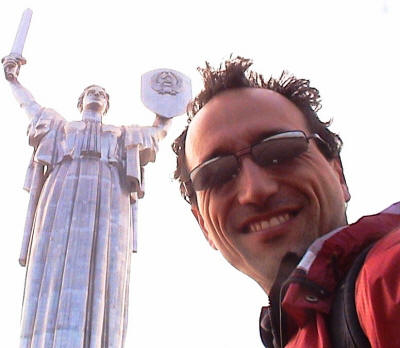
 Another example of a communist leftover was the controlling and corrupt police force. In 2004, when I saw Kyiv’s colossal titanium Mother Motherland statue from far away, I used my camera’s zoom to take a photo. While snapping the picture, a policeman ran up and ordered me to stop. He thought I was taking a photo of a nearby military building that was in the line of sight of the distant statue. I showed him the photos so that he could believe me when I said that I wasn’t a spy.
Although I never faced corruption during any of my visits, in 2010, travel blogger Justin Klein got “shaken down” by police officers on five separate occasions during a short trip.
He offered tips on how to avoid such encounters:
- Keep quiet when the police are around (so they don’t overhear you speaking English).
- If they ask you for a bribe, reinforce that you’re just a poor traveler who is staying in cheap hostels and traveling on second-class trains.
- Say that you’ve already had to pay other officers “fees” for minor “violations.”
- Carry little cash in your wallet (or at least the wallet you show them); they’re unlikely to walk you to a bank to get more money, so you might get away with a small bribe.
- Pretend you don’t understand them and hope they get bored.
Justin nearly left Ukraine early out of frustration, but he’s glad he stayed because he loved the people and the country overall.
Another communism hangover is that arbitrary rules are posted everywhere. Fortunately, it’s all in Cyrillic so you probably won’t understand them, although I learned to spot their favorite phrase, “Strictly Forbidden!” Ukrainians probably ignored half of the rules under communism, but nowadays they seem to ignore all the rules.
The strictness of our laws is compensated for by their lack of enforcement. — Whispered Soviet saying
Kyiv is an attractive city that delicately mixes splendid old architecture, glass skyscrapers, and crappy-looking commie buildings. Kyiv was the center of Kievan Rus’, Europe’s largest and most powerful medieval state. Its finest symbol is the Saint Sophia Cathedral and its nearby Cave Monastery, which together make up one UNESCO World Heritage Site. Thousands of worshipers kiss glass enclosures that cover a saint’s tomb or icon. I hope they clean the glass often.

With 2.7 million residents, there’s plenty to see and do in Kyiv. My favorite place is the cozy Andriyivsky Uzviz (Andrew’s Descent). It’s a descent down a charming cobblestoned street that takes you to the baroque-styled St. Andrew’s Church. Nearby vendors promote a vast selection of matryoshkas (stacking dolls). Although Kyiv is a superb city, Ukraine is big and I wanted to see more, so I went to Odessa.
This is an excerpt of The Hidden Europe: What Eastern Europeans Can Teach Us. You might want to read about when I first visited Ukraine in 2004 and listen to my WanderLearn Ukraine Podcast.
Recommended reading
Read up about Ukraine in Wikipedia and Ukraine in the CIA Factbook.
Travel deals to Ukraine
Check my favorite travel sites:
Interactive map of Ukraine
View Larger Map