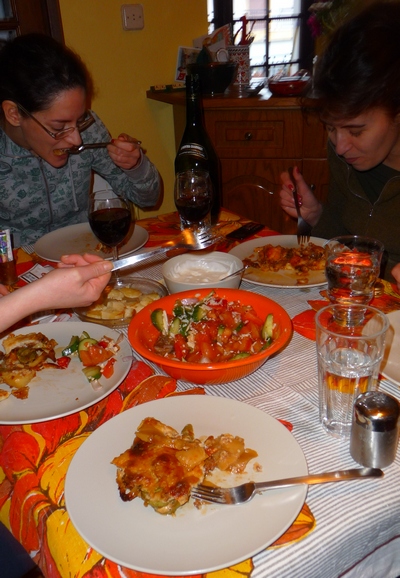
 According to my tastes, Greece has the most delicious food in Eastern Europe. They energize their meals with fresh ingredients like tomatoes, eggplant, feta cheese, onions, olive oil, yogurt, zucchini, nuts, and honey. During the Byzantine and Turkish period, Greeks incorporated spices like oregano, dill, bay leaves, and mint.
Today, popular dishes include souvlaki (anything marinated in olive oil, salt, pepper, oregano and then skewered), dolmathes (grapevine leaves stuffed with rice, veggies, and sometimes meat), and tzatziki (yoghurt with garlic and cucumber). Even their fast food is delicious: gyros (meat roasted on a vertically turning spit and served with sauce and garnishes on pita bread) will make you give up hamburgers. Finally, baklava (phyllo pastry layers filled with nuts and drenched in syrup or honey) is a decadent dessert to end any meal.
It’s all Greek to me
Over dinner, my four Greek hosts gave me a crash course on Greek. Niki was particularly instructive because she has a degree in the ancient Greek language. Basic phrases include yashoo (hello), adio (goodbye), puinne. . . (where is. . .), posho kani? (how much?), tikanish? (how are you?), treno (train), pote (when), tikanish? (how are you?), poli kalo (very good), katalava (understand), signomi (sorry), and, most importantly, efharishto (thank you).
About every 10 minutes Niki (whose name means Victory) loved to remind me that some English words I said were derived from Greek. She could have interrupted me more often: about 12 percent of the English vocabulary has an ancient Greek origin, including words like mathematics, astronomy, democracy, philosophy, thespian, athletics, theater, and rhetoric.
Still, this doesn’t mean Greek is easy for us. Most Greek verbs are irregular. They have four cases. They even have three ways to write their sigma character. The first is upper case (Σ), the second is lower case (σ), and the third is used only when the word ends with the sigma character (ς). Σo σentenceς would read juσt like thiς.
There are two other annoying things besides the Greek alphabet. First, while most European countries use a word that sounds like bus or autobus, the Greeks call that vehicle a leoforio. WTF? Second, to say yes, you have to say neh, which sounds like a negation in most European languages. So when I ask, “So the leoforio leaves today?” they’ll nod and say, “Neh!” Meanwhile, to say no, you say ohhi. As William Shakespeare said, “For my part, it was Greek to me.”
There is a misleading, unwritten rule that states if a quote giving advice comes from someone famous, very old, or Greek, then it must be good advice. — Bo Bennett
After stuffing ourselves with Niki’s divine cooking, the five of us talked for hours. Niki would be working most of the night at a bar, so she told me to sleep in her room. When she came home at 4:00 a.m. she would go sleep in Maria’s room. The next day she promised to give me a tour of Thessaloniki.
Busted in Thessaloniki
The next morning, I woke up to what sounded like an air raid. Vendors in pickup trucks use megaphones to announce that they have potatoes or other items to sell. If you don’t speak Greek, then these megaphone announcements sound like air-raid warnings. It was a relief that big, bad Macedonia wasn’t finally launching their planned attack against the poor, defenseless Greece.
In the late morning, Niki woke up and soon got ready. To avoid a 40-minute walk to the center, we took a bus. She assured me that we didn’t need to buy a bus ticket because nobody ever checks. Of course, two ticket checkers caught us. Clever Niki pretended to be a tourist from Norway and I was her “husband from America.” The ticket checkers made us get off the bus and said, “You can either pay $150 later or pay $50 in cash right now.”
Niki said, “We’ll pay later.”
She gave her address and they left. Then she said, “Don’t worry. They will never, ever send us the bill. The Greek government is so disorganized. Even if they send it, you can ignore it and nothing will happen. But God, I can’t believe what those guys were saying about us on the bus! After I said that we were foreigners, they started saying the rudest things you can possibly imagine in Greek. It was hard not to react! Be glad you didn’t understand.”
After that thrilling start, we walked everywhere and avoided buses.
About Thessaloniki
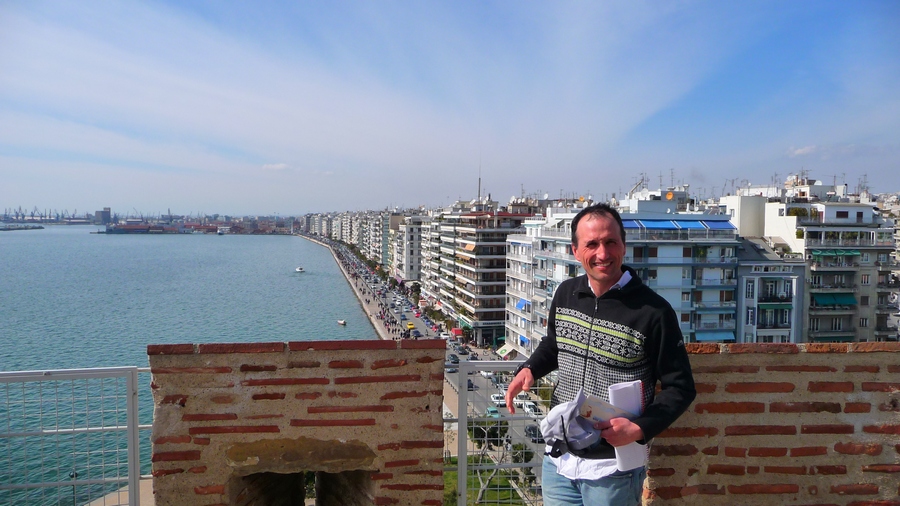
Thessaloniki is Greece’s second largest city and the capital of Greece’s Macedonia. The greater metropolitan area has nearly one million inhabitants. It was founded in 315 BC and was named after Thessalonike, the half-sister of Alexander the Great. By 1519, half the city became Jewish when the Muslim Turks invited Jews who were booted out of Spain to settle there. In 1913, they had about 61,000 Jews, about 40 percent of the population. In 1917, a massive fire destroyed the city and many Jews left. The Nazis took care of the remaining ones in the 1940s. Today, just 1,200 Jews remain, about 0.27 percent of the population.
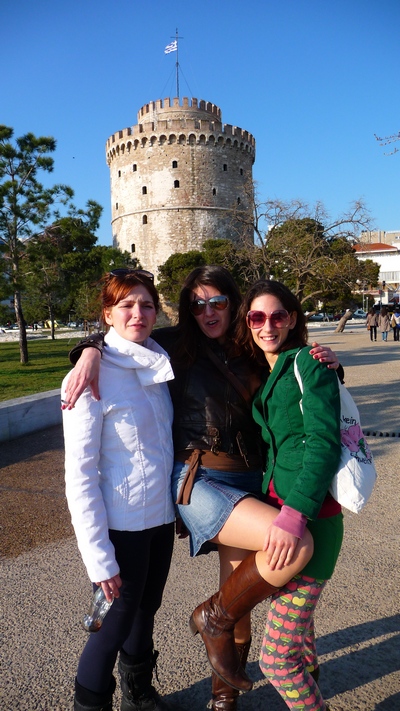
Thessaloniki has nine UNESCO World Heritage Sites, which is more than any other Greek city. We saw several, including the huge Hagia Sophia Church. When we walked by the grand Aristotelous Square, Niki told me that in 1997, Thessaloniki was the Cultural Capital of Europe.
Despite all the recognition, Thessaloniki (like Athens) isn’t as gorgeous as you might expect. It’s the ancient Greece marketing curse: Greece is overly hyped. In 2012, Thessaloniki is starting a massive 15-year renovation project, so that reality matches the marketing by 2027.
This is an excerpt from the chapter on Greece in The Hidden Europe: What Eastern Europeans Can Teach Us.