|

Today I was honored to be a guest on Rick Steves's national station show, which airs on 170 radio stations.
In case you missed it, you can hear it now as a podcast. My interview with him starts at minute 14. Download the MP3 now!
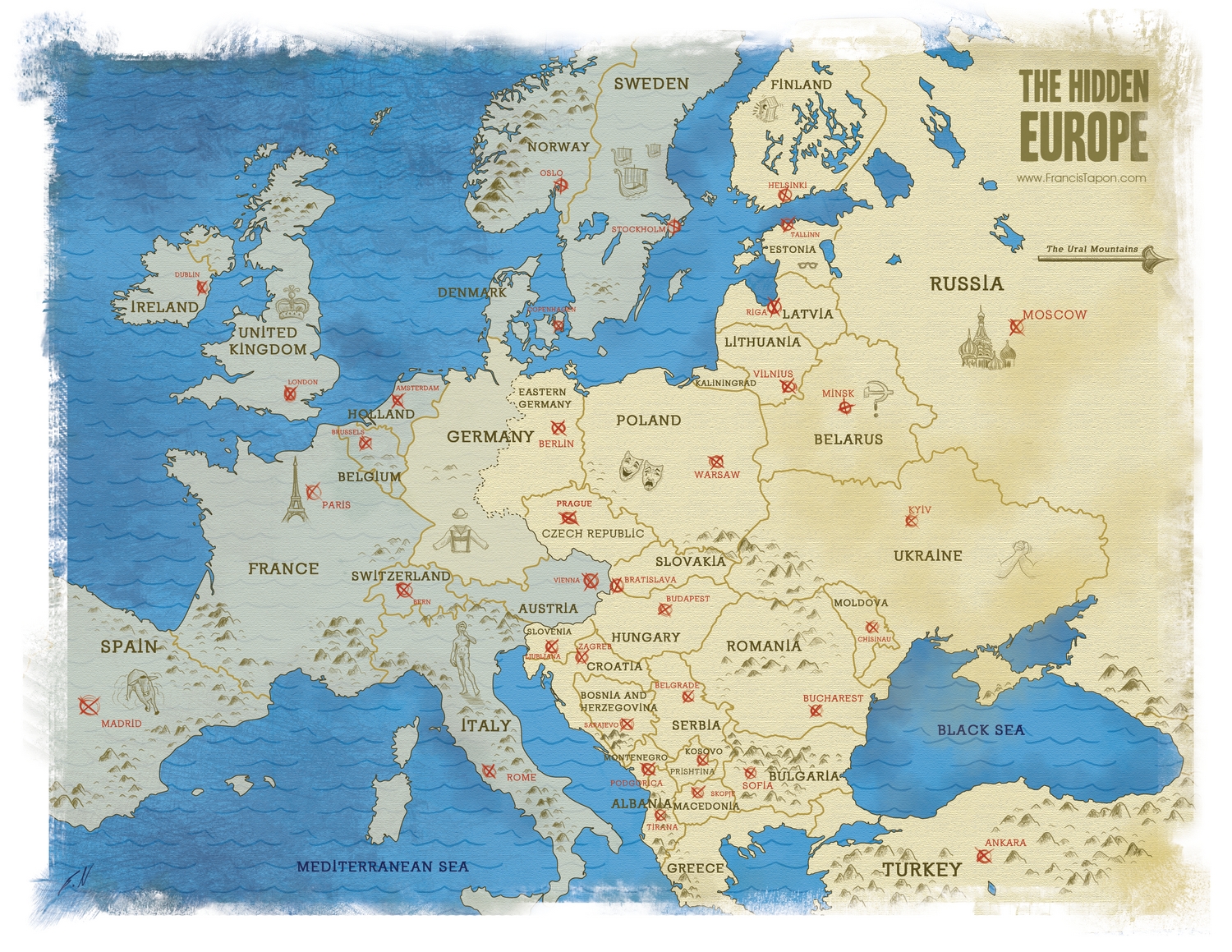
Rick called The Hidden Europe "an invigorating narrative packed with useful tips and colorful stories. . . . It's an entertaining summary of [Eastern Europe]."

Rick Steves has been one of my heroes because he's always advocated independent travel and encouraged Americans to fly across an ocean to explore.
Therefore, it was an absolute honor to be on his show.
As Rick himself admitted, he's focused most of his life on Western Europe. I was thrilled that he was interested in revealing Europe's hidden side: Eastern Europe.

It's impossible to adequately cover a 750-page book that covers 25 countries in a 25-minute interview.
Therefore, if you're interested in learning more about Europe's other side, please pick up a copy of my book, The Hidden Europe: What Eastern Europeans Can Teach Us.
You can get an autographed copy in my shop. You can also get the hardcover or ebook on Amazon.
I'm also available open to being a guide, delivering speeches, and helping you with personal coaching. See my services.
Lastly, you can give me feedback, connect with me on Facebook, Twitter, and subscribe to my RSS feed or newsletter by going to my contact page.
Thank you for tuning in!
 
|
|

Ben Brown has written this guest post....
What’s more liberating than travel? You get to see people, places, and things that you don’t normally see. In the past, traveling the world was restricted to only the privileged few that could afford it. Today, almost everyone can travel to just about any corner of the globe. So, what’s stopping you from taking that solo-backpacking trip across Eastern Europe? Go ahead and find some cheap flights and start making memories today!
Backpacking across Eastern Europe is a great way to learn a bit of history, view the scenery, and meet new people from a completely different culture to your own. There are numerous historical monuments and sights of interest to visit in the countries of Eastern Europe.
While most individuals prefer backpacking in Europe with a few friends, there’s nothing wrong with wanting to take such a trip alone. It will allow you the opportunity to see the sights you want to see and learn something about who you really are. Don’t let mom talk you out of it because she thinks it could be dangerous. Backpacking around Europe can be quite safe and is great fun. To keep safe you just need to know what you’re doing and to have a comprehensive plan. Keep these tips and suggestions in mind and have a great time!
|
|
Read more... [Backpacking solo in Eastern Europe: Things You Should Know]
|
|
Imagine if the Grand Canyon were underground—that should give you an idea of what to expect when you enter the Škocjanske Jame (Škocjan Caves). Lonely Planet listed them as one of the top 10 attractions in Eastern Europe. They’re also on the UNESCO World Heritage list and get 100,000 visitors a year. They live up to their reputation by being one of the largest underground canyons in the world with the Reka river still carving through it. At 60 meters wide and 140 meters deep, this canyon is a fraction of the Grand Canyon’s size, but the fact that it’s all underground makes it feel bigger. When you cross the canyon via the narrow Hanke Canal Bridge, you’ll see the roaring river far below. You’ll realize that you could fit a fat 45-story skyscraper in this subterranean world.
The Škocjan underworld is so enormous that a unique ecosystem has evolved here—it’s home to strange blind creatures that have never seen sunlight. The most bizarre one is the proteus. Slovenians informally call it the človeška ribica (human fish). This alien vertebrate is as long as your forearm, has a long tail for swimming, gills, four legs, pigment-free skin, a highly sensitive nose, a sensor for detecting weak electrical fields in the water, and a pair of atrophied lungs and eyes that don’t really work. They’re a weird amphibian that lives almost exclusively in water. Their life cycle is mystifying: they live almost as long as humans, they become sexually mature as teenagers, they have never been seen reproducing in the wild, their babies hatch out of eggs, and they can live up to 10 years without food. It’s one of the most hidden creatures in the Hidden Europe.

|
|
Read more... [3 Otherworldly Caves in Slovenia]
|
|

While I was traveling in Eastern Europe, my high-school friend, Sarah Spiridonov, made me an offer I couldn't refuse. I hadn't talked with Sarah since we were 18 years old, but thanks to Facebook, we reconnected. She was married to a Bulgarian and they had two boys. To help me with my book, she generously proposed that I stay a couple of weeks in her family's summer home in Turkincha, a tiny village about 20 kilometers (12.5 miles) from Veliko Tarnovo. I was extremely grateful for the opportunity to take a closer look at a rural Bulgarian setting. The experience ended up surprising me in numerous ways.
The village of Turkincha

|
|
Read more... [Oddities in Turkincha, Bulgaria]
|
|
One Ukrainian tourist website proclaims: “Ukraine is the geographical center of Europe!” And then, confusingly, the first sentence after that title is, “Ukraine is one of the mightiest countries in Eastern Europe.”
One of those proclamations is true: Ukraine is the biggest country that is wholly in Europe. Russia’s European piece is bigger than Ukraine, while Denmark is bigger than Ukraine if you count its Greenland territory. However, if you ignore these two cases, then Ukraine is the biggest. In fact, it’s almost as big as Texas.
Starting in 1999, I visited Ukraine every five years. Each time I returned, Ukraine seemed to have taken three steps forward and two steps backward.
Traces of communism
In 1999, I flew into Ukraine’s capital, which is often called Kiev, but we will use its official name: Kyiv (pronounced Kee-v). I stayed in the Mir Hotel. I learned that mir is a cool Eastern Slavic word that has two meanings: world and peace.
Although communism had officially disappeared nearly a decade before, its remnants were everywhere. For example, every floor of the hotel had a middle-aged, overweight female gatekeeper who was in charge of the floor. Besides having the thrilling task of policing the floor, this stern woman would also hold your keys, which clearly the receptionist in the lobby was incapable of doing. Similarly, at the bottom of every subway escalator, there was a guard whose stimulating job was to verify that life around the escalator was OK. Communism’s goal was to give everyone a job, so it invented millions of useless jobs. Many of these pointless jobs remain.
Another example of a communist leftover was the controlling and corrupt police force. In 2004, when I saw Kyiv’s colossal titanium Mother Motherland statue from far away, I used my camera’s zoom to take a photo. While snapping the picture, a policeman ran up and ordered me to stop. He thought I was taking a photo of a nearby military building that was in the line of sight of the distant statue. I showed him the photos so that he could believe me when I said that I wasn’t a spy.
Although I never faced corruption during any of my visits, in 2010, travel blogger Justin Klein got “shaken down” by police officers on five separate occasions during a short trip.
He offered tips on how to avoid such encounters:
- Keep quiet when the police are around (so they don’t overhear you speaking English).
- If they ask you for a bribe, reinforce that you’re just a poor traveler who is staying in cheap hostels and traveling on second-class trains.
- Say that you’ve already had to pay other officers “fees” for minor “violations.”
- Carry little cash in your wallet (or at least the wallet you show them); they’re unlikely to walk you to a bank to get more money, so you might get away with a small bribe.
- Pretend you don’t understand them and hope they get bored.
Justin nearly left Ukraine early out of frustration, but he’s glad he stayed because he loved the people and the country overall.
Another communism hangover is that arbitrary rules are posted everywhere. Fortunately, it’s all in Cyrillic so you probably won’t understand them, although I learned to spot their favorite phrase, “Strictly Forbidden!” Ukrainians probably ignored half of the rules under communism, but nowadays they seem to ignore all the rules.
The strictness of our laws is compensated for by their lack of enforcement. — Whispered Soviet saying
|
|
Read more... [Ukraine]
|
What divides Romania and Moldova
My bus crossed the Prut River, which divides Romania and Moldova. It’s basically the only thing that divides Romania and Moldova. Linguistically, they’re identical. In 2002, the Moldovan Minister of Justice said that Romanian and Moldovan are the same language. Moldova’s Education Minister and President agreed. Nevertheless, in 2003, a Moldovan-Romanian Dictionary was published, which is about as useful as having a New York-Texas Dictionary—a complete waste of paper.
Moldova is torn: among its population, three times more people claim to speak Moldovan than to speak Romanian. Since the only real difference between these languages is their name, this poll implies that Moldovans believe that there’s more than just the Prut River that separates them from Romanians.
A 2009 survey indicated that 47 percent of Moldovans believe that the Romanian and Moldovan identities are “different” or “entirely different,” while only 26 percent felt they were “the same” or “very similar.”
The Soviets encouraged the belief that Moldovans are different than Romanians by making Moldovans use the Cyrillic alphabet. This took Moldovans back over 200 years, when they (and the Romanians) used the Cyrillic alphabet. However, after gaining their independence from the USSR 20 years ago, Moldovans reverted to the Latin alphabet, thereby making their language indistinguishable from Romanian. Nevertheless, the notion that they are different remained. That partly explains why most Moldovans do not want to reunite with Romania.
Ethnically, 70 percent are Moldovan/Romanian and 20 percent are Russian/Ukrainian. Most Slavs live on Moldova’s eastern edge, where they make up the majority. Lastly, four percent of Moldovans are ethnic Gagauz, who are Christians that speak a Turkish dialect. The reason this tiny country is so divided is that the region has traded among various rulers more times than a stock on the New York Stock Exchange.

|
|
Read more... [Moldova]
|
|

Hallelujah! That's what I shouted when I first entered Romania.
It was September 2004 and I had spent the previous four months traveling in countries that spoke languages that were either Baltic, Slavic, or Martian (i.e., Hungarian and Albanian).
For many moons I was hopelessly illiterate: my knowledge of Romance languages was useless and my ludicrously simple Russian was futile.
Finally, I found an Eastern European language that felt familiar and easy. Sure, I only understood about 20 percent of it, but Romania felt like a Latin oasis in a Slavic desert.
The Romanian language brings up the tiresome defining-Eastern-Europe debate again. We've primarily used geography to define Eastern Europe, although we've also considered Eastern Europe's common historical connection to communism.
Still, there's another way to draw Europe's east-west dividing line: using the Catholic-Orthodox borderline. In that case, Lithuania, Poland, Hungary, Slovakia, Croatia, and Slovenia would all fall on the Catholic side, while Russia, Belarus, Ukraine, Romania, and much of the Balkans would fall in the Orthodox camp.

|
|
Read more... [Romania]
|
|
|